A case report led by UCLA Health researchers highlights the importance of a multidisciplinary, evidence-based approach to treating prostate cancer that returns after surgery, particularly when the disease recurs multiple times and in different locations.
The study, published in CA: A Cancer Journal for Clinicians, shows how advanced PSMA imaging and targeted therapies are helping doctors identify and treat small areas of recurrent prostate cancer, while clinical trials investigate ways to address microscopic disease that may remain too small to detect.
The report follows Larry Hardesty, 76, who is also a co-author of the paper, over more than a decade as his prostate cancer returned three times following surgery. After coming to UCLA, Hardesty enrolled sequentially in three investigator-initiated clinical trials led by radiation oncologist Dr. Amar Kishan, with his treatment evolving as the cancer appeared in new locations. Following treatment on the third trial, his PSA became undetectable and follow-up imaging showed no evidence of active disease.
His treatment included highly targeted radiation therapy, intensive hormone therapy and, after his third recurrence, a PSMA-targeted radioligand therapy designed to deliver radiation directly to prostate cancer cells throughout the body. Following the third treatment, his PSA, a blood marker used to monitor prostate cancer, became undetectable. Follow-up PSMA scans at one and two years showed no evidence of active disease.
“Recurrent prostate cancer can look very different from one patient to another and even within the same patient over time,” said Kishan, who is the first author of the study, professor and executive vice chair of radiation oncology at the David Geffen School of Medicine at UCLA and co-director of the cancer molecular imaging, nanotechnology and theranostics program at the UCLA Health Jonsson Comprehensive Cancer Center. “This case shows why multidisciplinary care is so important. We have to bring together what we know from imaging, radiation, systemic therapy and clinical trials and continually reassess the best approach as the disease changes.”
Adapting treatment as prostate cancer changes
Prostate cancer can often be treated successfully with surgery or radiation, but some patients experience a recurrence. For patients who have undergone prostatectomy, a rising PSA can be the first sign that cancer has returned.
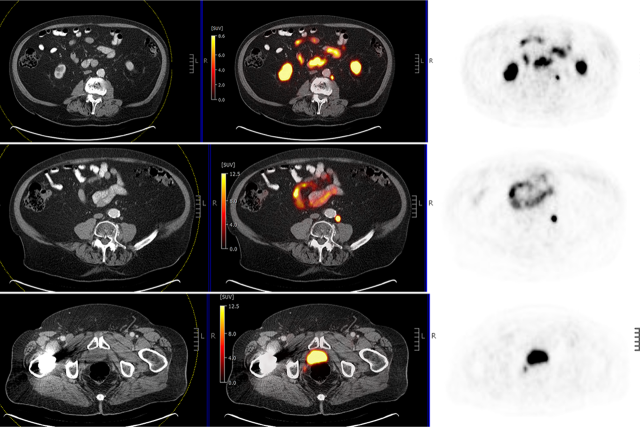
In this case, the patient's PSA became detectable about three years after surgery. A PSMA PET/CT scan identified a small recurrence in the prostate bed and several lymph nodes containing cancer. He received stereotactic body radiation therapy, or SBRT, a highly focused form of radiation, but the cancer later returned in lymph nodes farther up the abdomen.
The recurrence highlighted a limitation of even highly sensitive imaging. Doctors can treat tumors visible on a PSMA scan, but microscopic cancer may already exist elsewhere in the body.
When the cancer returned a second time, the patient enrolled in the SATURN clinical trial and received SBRT along with six months of intensive hormone therapy. His PSA fell but eventually began to rise again, and a subsequent PSMA scan identified two new cancerous lymph nodes and another recurrence in the prostate bed.
For his third recurrence, he enrolled in the phase 2 LUNAR trial and received two cycles of 177Lu-PNT2002, a radioligand therapy designed to seek out PSMA-positive cancer cells and deliver radiation directly to them, followed by SBRT.
His PSA eventually became undetectable, and PSMA scans at 12 and 24 months showed no evidence of active disease. His PSA remained undetectable through 10.5 years after his prostatectomy.
Looking back on his treatment journey, Hardesty, who contributed his perspective as a co-author of the case report, said he is grateful he had the opportunity to participate in the clinical trials and believes the final approach made the difference.
“I have felt fortunate to have access to so many trials, and even though two of them didn’t work, I feel like I received cutting-edge care,” Hardesty said. “And this last one seems to have done the trick.”
Why multidisciplinary care matters
The case demonstrates how managing recurrent prostate cancer can require different specialists and treatment strategies as the disease evolves. Over more than a decade, the patient’s care incorporated expertise in urology, radiation oncology, medical oncology, nuclear medicine and advanced imaging, with treatment decisions guided by the location of his cancer, his previous therapies and the best available evidence.
The case also reflects how advances in prostate cancer care have created more options while making treatment decisions more complex. PSMA imaging can detect smaller areas of recurrent disease, SBRT can precisely target individual tumors, and PSMA-targeted radioligand therapies offer a way to potentially reach cancer cells beyond what can be seen on a scan.
“This isn’t a story about one treatment being the answer,” Kishan said. “It’s about bringing together different areas of expertise and using the evidence available at each point in a patient’s journey to make the best treatment decision we can. As the cancer changes, our approach has to change with it.”
Clinical trials were also central to the patient’s care. Each of his three recurrences was treated through an investigator-initiated UCLA trial, allowing him to receive emerging approaches while contributing evidence that may help guide treatment for future patients.
The researchers note that ongoing randomized clinical trials will help answer important questions about when to use hormone therapy, which patients benefit most from metastasis-directed radiation and how PSMA-targeted radioligand therapy can best be integrated with other treatments.
The study’s senior author is Matthew Rettig, professor of urology and medical director of the prostate cancer program at the David Geffen School of Medicine at UCLA. Other authors, all from UCLA, are Yulia Zekster, Adam Singer, Kekoa Taparra, Luca Valle, Michael Steinberg, Nicholas Nickols, Robert Reiter, Johannes Czernin, Jeremie Calais and John K. Lee.