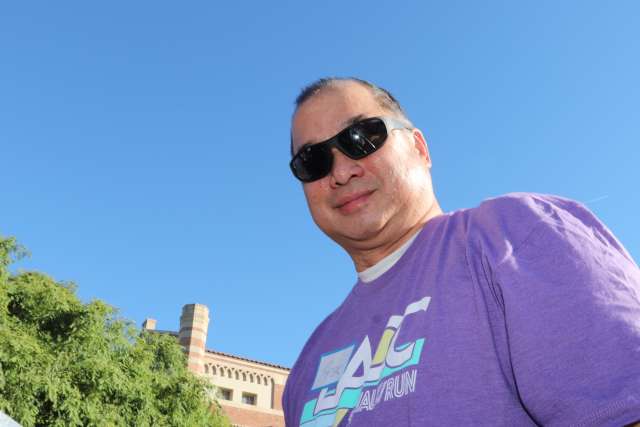
Peter Lau went to his first LA Cancer Challenge 5K two years ago just to cheer on his friends.
A once avid hiker and biker, he was diagnosed with stage IV pancreatic cancer in the fall of 2023 and his energy was depleted. He thought he’d be able to walk just a quarter-mile of the UCLA campus course and then root from the sidelines.
“We started walking, surrounded by all of these people,” Lau reflected. “All of a sudden we hit a quarter-mile and a half-mile, and I was like hey, I’m going to keep going,” he says.
His caregiver tapped out, he remembers with a laugh, but he continued through the rolling campus, walking sticks in hand, up “The Hill” – with its challenging incline – and soon found himself at the finish line.
“It was really nice just to achieve something,” he said.
The LA Cancer Challenge (LACC), hosted by the Hirshberg Foundation for Pancreatic Cancer Research, is a 5K fund-raising walk supporting the nonprofit’s mission to raise funds for pancreatic cancer research and to provide resources for patients and their families.
At this year’s LA Cancer Challenge, in October, Lau didn’t just participate in the race, he was the Honorary Starter. With his friends’ support, he was also the top fundraiser, collecting more than $117,000 for the Hirshberg Foundation.
A personalized treatment plan
When Lau was diagnosed with pancreatic cancer, he was told chemotherapy could extend his life by three to six months. His first question, he recalled, was, “Why should I suffer six months of chemotherapy just to gain a few more months?”
As a young kid, Lau would accompany his mother to her breast cancer chemotherapy sessions, supporting her through the nausea on rides home. He anticipated a similar experience.
“(My doctors) said, ‘We don’t know if you’re going to suffer. Why don’t you try it and you see?’ I tried it and it really wasn’t that bad,” Lau said.
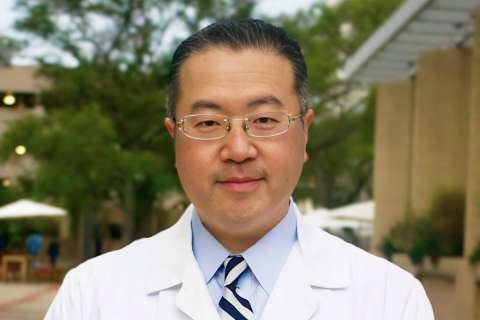
A few months later, Lau joined a clinical trial at UCLA Health. His oncologist, Sidharth Anand, MD, worked with him to develop a personalized treatment plan that includes innovative clinical trials, psychosocial support from the Simms/Mann UCLA Center for Integrative Oncology, and integrative care from the UCLA Center for East/West Medicine.
“The way I think about cancer is not just from the lens of treating a disease or a pathway, but rather providing whole-person care in order to fight their disease on many fronts,” Dr. Anand explained.
Most recently, Dr. Anand and the UCLA research team helped Lau gain access to a new treatment, Daraxonrasib (marketed as RASONQUE), which inhibits a previously untargetable pathway common among more than 90% of people with pancreatic cancer. The drug has been shown for many patients to double their survival compared to standard chemotherapy, Dr. Anand explained.
UCLA was an early participant in the clinical trials of the drug, which showed promising results. However, patients could not access it while it was pending Food and Drug Administration approval. That wouldn't come until August.
In the meantime, Dr. Anand worked with the UCLA Oncology team to rapidly open an expanded access program for patients such as Lau with metastatic pancreatic adenocarcinoma. “We were one of the early centers in the country to open access to the treatment for patients before FDA approval,” he said.
As part of the program, Lau was able to start the treatment in June.
Lau had been following the clinical trials for this new treatment for more than two years. Now on the drug, he no longer has to go in person for weekly chemotherapy treatments. “It’s crazy,” he said. “I just take a few pills every day.”
Having access to the treatment is especially meaningful in how he remembers a friend who was part of the first phase of the clinical trial three years ago, he said.
With its decreased side effects, the new treatment made it possible for Lau to take his first trip in three years, out to Mammoth, in October.
You’ve got to let people know there is hope
At his first LACC walk three years ago, Lau spoke to Agi Hirshberg, founder of the Hirshberg Foundation and philanthropist for whom the UCLA Agi Hirshberg Center for Pancreatic Diseases is named. She asked how he was doing. His treatments were going well, he said, but he felt unsure about sharing that in front of others who may have been facing greater challenges.
Noticing his reluctance, Hirshberg encouraged him to speak up. He recalled her saying: “You have to tell people who Google it, and worry they’ll have only three months, that there is hope.”
“It was life-changing,” Lau said.
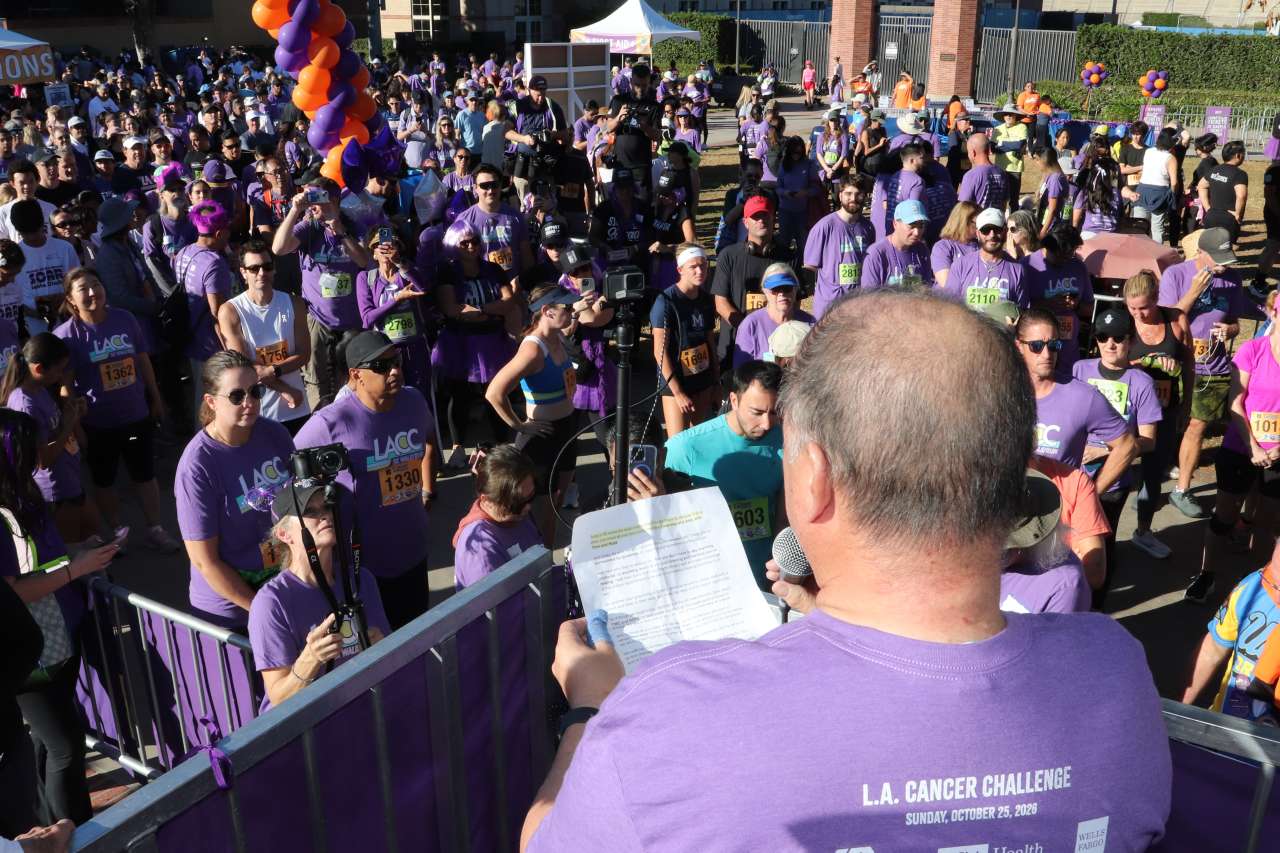
Lau was inspired to be more active in the Hirshberg Foundation, attending patient support groups, speaking about his treatment journey at research symposiums, and bringing survivors together.
LACC became a gathering point for his online support group to meet in person, talk through their experiences managing side effects and share recommendations for where to get second opinions. For many patients, it’s also the first opportunity to see another patient.
“Oncology needs to be collaborative, and Peter has been extremely helpful in that way,” Dr. Anand said, adding that Lau regularly shares about his cancer support group and about members’ experiences navigating trials and approaches at other centers. “He’s advocating for them as much as he’s advocating for himself.”
Lau also started a blog about his treatment journey in which he logs his rounds of chemotherapy and writes about his experience navigating the complexities he faces as a patient. He also shares about people and events that inspire him and requests prayers for him and others affected by his condition.
He originally started the blog to help answer some of the questions his friends and family had as he began treatment. As much as writing the blog can be cathartic, it also protects him from constantly reliving his experience as he answers questions, he explained. He also realizes that when people ask how he was diagnosed, they are often seeking ways to diagnose themselves.
“Mostly, I write the blog to say hey, look, this is what’s going on inside me,” he said. “I’m just trying to put my feelings or thoughts out there, so if you haven’t thought about it, maybe you can, and you can start processing.”
Who are you walking for?
In his kickoff speech at the 2026 LACC, Lau asked attendees to make the most of the opportunity to walk with each other and to share their stories.
“Today you’re surrounded by thousands of inspiring and sometimes hurting people. Ask them who they’re walking for,” he said.
As he led the walk, he reflected on his experience walking with his mother.
When he was a UCLA student, he would walk with her through campus, accompanying her to appointments.
“Now this is my turn, and doing the walk, you’ve got so much time to reflect,” he said. As he walked, he spoke with other attendees also revisiting the campus as patients.
Dr. Anand attended the walk and emphasized just how many people showed up to support Lau.
“He’s touched a lot of lives,” Dr. Lau said. “His work with the Hirshberg Foundation and in his support groups has been transformative for those facing similar journeys, supporting them in alleviating their fears heading into treatment, and in advocating for themselves to gain access to clinical trials.”

With November being Pancreatic Cancer Awareness Month, Dr. Anand points out that patients just starting this journey are not alone.
“Unfortunately, the incidence of pancreatic cancer is rising. Anyone with a family history of pancreatic cancer or genetic mutations associated with cancer, such as BRCA, should talk to their primary care physician about the appropriate screening,” he said.
“Tapping into community, whether it be your family, friends, faith, or support groups, can keep your hope and spirit up, making a world of difference.”