
Quantitative Pipeline & Individual Course Descriptions
Quantitative Pipeline
STREaM trainees will be assigned a primary STREaM mentor who will work with the trainee to map out an individual curriculum, drawn from the available coursework, and tailored to the individual trainee’s educational goals. STREaM is not a “one size fits all” curriculum. The coursework available through STREaM US-based partner institutions can be placed along a spectrum of complexity, from fundamental conceptual courses through advanced machine learning application (Figure 1).
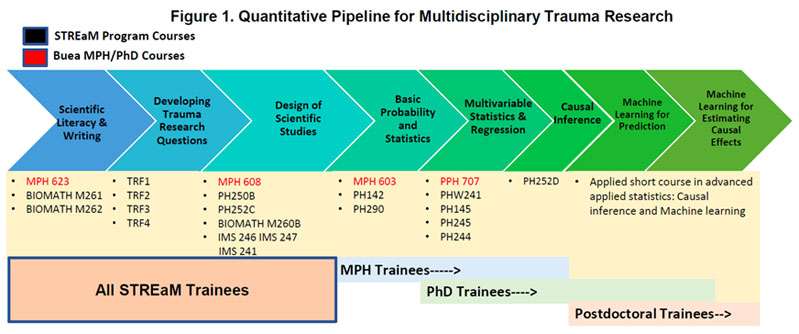
STREaM Program’s goals are to create a multidisciplinary cohort of injury control and trauma research experts who can use their different backgrounds and skill sets to work together to reduce the burden of trauma in Cameroon. Accordingly, each trainee may enter the quantitative pipeline at a level suitable to their background, then continue along this pipeline until their scholastic goals are met. This model allows one set of course offerings to be flexible enough to adapt to each trainee’s individual academic background and ability at baseline, then grow with them until they achieve their target skill level. The intended outcome of this approach is to create an academically diverse cohort with a minimum fundamental fluency in quantitative methodology to allow their academic backgrounds to interact as a complementary, transdisciplinary team.
Course Offerings
STREaM Cameroon will draw on the rich resources of its partner institutions to provide trainees coursework from Buea, UCLA, UC Berkeley, and UCSF. In addition to the required MPH and PhD courses at Buea, STREaM trainees will have access to the courses listed in the table below.
| "Institution" | Course # | Course Title | Duration | STREaM Audience |
|---|---|---|---|---|
| PASE-UCLA | TRF 1 | Injury Epidemiology | 8 weeks | All trainees |
| PASE-UCLA | TRF 2 | Injury Prevention | 8 weeks | All trainees |
| PASE-UCLA | TRF 3 | Trauma Systems | 8 weeks | All trainees |
| PASE-UCLA | TRF 4 | Trauma Quality Improvement | 8 weeks | All trainees |
| UC Berkeley | PBH250B | Epidemiologic Methods II | 15 weeks | MPHs, PhDs as needed |
| UC Berkeley | PHW252C | Intervention Trial Design | 15 weeks | MPHs, PhDs as needed |
| UC Berkeley | PH142 | Introduction to Probability and Statistics in Biology and Public Health | 15 weeks | MPHs |
| UC Berkeley | PH290 | R for Public Health | 15 weeks | MPHs, PhDs, Post Docs as needed |
| UC Berkeley | PH241 | Statistical Analysis of Categorical Data | 15 weeks | MPHs, PhDs as needed |
| UC Berkeley | PH145 | Statistical Analysis of Continuous Outcome Data | 15 weeks | MPHs, PhDs as needed |
| UC Berkeley | PH245 | Introduction to Multivariate Statistics | 15 weeks | MPHs, PhDs, Post Docs as needed |
| UC Berkeley | PH244 | Big Data: A Public Health Perspective | 15 weeks | PhDs, Post Docs |
| UC Berkeley | PH252D | Introduction to Causal Inference | 15 weeks | MPHs, PhDs, Post Docs as needed |
| UC Berkeley | Applied short course in advanced applied statistics: causal inference and machine learning | PhDs, Post Docs | ||
| UCLA CTSI | BIOMATH M261 | Responsible Conduct of Research Involving Humans | 10 weeks | All trainees |
| UCLA CTSI | BIOMATH M262 | Communication of Science (Grant Writing) | 10 weeks | All trainees |
| UCLA CTSI | BIOMATH M260B | Methodologies in Clinical Research Longitudinal and Community Studies | 10 weeks | All trainees |
| UCSF CTSI | IMS 245 | Introduction to Implementation Science Theory and Design | 10 weeks | MPHs, PhDs, Post Docs as needed |
| UCSF CTSI | IMS 246 | Designing Individual-Level Implementation Strategies | 10 weeks | MPHs, PhDs, Post Docs as needed |
| UCSF CTSI | IMS 247 | Designing Interventions to Change Organizational Behavior | 10 weeks | MPHs, PhDs, Post Docs as needed |
| UCSF CTSI | IMS 248 | Community Engaged Research | 10 weeks | MPHs, PhDs, Post Docs as needed |
| UCSF CTSI | IMS 242 | Program Evaluation in Clinical and Public Health Settings | 10 weeks | MPHs, PhDs, Post Docs as needed |
| UCSF CTSI | IMS 241 | Study Designs for Intervention in Real World Settings | 10 weeks | MPHs, PhDs, Post Docs as needed |
Coursework at UC Berkeley
UC Berkeley courses spanning increasingly sophisticated analytic and statistical methodology, ranging from basic probability and statistics, study design, and multivariable regression through more complex topics for PhD and postdoc-level trainees such as causal inference and machine learning. Most of the selected courses are already designed for remote learning with the input of experienced instructional designers and employ best practices for asynchronous learning.
- Epidemiologic Methods II
- Intervention Trial Design
- Introduction to Probability and Statistics in Biology and Public Health
- R for Public Health
- Statistical Analysis of Categorical Data
- Introduction to Multivariate Statistics
- Big Data: A Public Health Perspective
- Introduction to Causal Inference
- Applied short course in advanced applied statistics: causal inference and machine learning
Coursework at UCLA-CTSI (Professional Development Curriculum)
The UCLA-CTSI Training Program in Translational Science offers an array of graduate-level courses, including those in research conduct, ethics, and grant writing. All STREaM trainees will take the following required coursework:
- Responsible Conduct of Research Involving Humans: Responsible conduct of clinical research, including reporting, basis for authorship, principles and practice of human research, conflicts of interest, IRBs, and related topics. Clinical Research Certificate is awarded at completion.
- Communication of Science: Details of writing scientific articles, review articles, grant submissions (aims, background, results, design), role of appendices, and communication with a lay public.
- Methodologies in Clinical Research, Longitudinal and Community Studies: Practices of research, including personnel management, data management, and research administration.
Coursework at UCSF-CTSI (Implementation Science)
UCSF-CTSI’s individual implementation science courses may be taken by postdocs, PhD, or MPH students, as interested. Students may also opt to take the UCSF CTSI certificate program by completing all six courses.
- Introduction to Implementation Science Theory and Design: Apply a conceptual framework for translating evidence into practice, policy, and public health; apply theory and evidence to the design of effective implementation strategies; evaluate and analyze implementation strategies.
- Designing Individual-Level Implementation Strategies: Behavior change theories across a range of contexts and intervention design frameworks. Application of theory and frameworks to select behavior change targets; characterize barriers and enablers of behavior change; and identify techniques likely to be effective in addressing key barriers and enablers of behavior change.
- Designing Interventions to Change Organizational Behavior: Surveys a range of translational tools at the system level to promote the adoption of evidence-based medicine by providers and delivery systems.
- Community-Engaged Research: Theory and practice of engaging stakeholders in intervention design, and implementation. Participatory research methods; adapt health interventions to real-world contexts.
- Program Evaluation in Clinical and Public Health Settings: Approaches to evaluating a health intervention in a clinical or public health setting. Logic models and evaluation frameworks to guide the collection of information to 1) understand if an implementation strategy is meeting goals and objectives; 2) improve implementation strategy effectiveness; and 3) make decisions about future programming.
- Study Designs for Intervention Research in Real-World Settings: The main components of alternatives to individual randomized control trials that can be used to evaluate interventions placed in real world settings. Discusses which design is most suited to a range of settings and circumstances.
STREaM Cameroon is supported by the Fogarty International Center of the National Institutes of Health under Award Number D43TW012186.