
Meet Our Team
Yvette Taché, PhD, AGAF
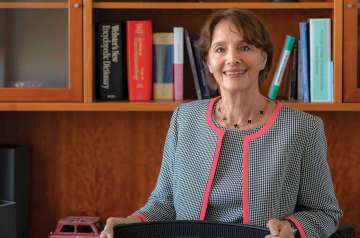
Distinguished Emeritus Research Professor of Medicine
Vatche and Tamar Manoukian Division of Digestive Diseases
David Geffen School of Medicine at UCLA
VA Greater Los Angeles Healthcare System
Dr. Taché joined UCLA's Division of Digestive Diseases in 1982. She was appointed professor-in-residence in 1987, named distinguished professor in 2009, and became distinguished emeritus research professor in 2025. Throughout her career, she maintained continuous, competitively funded research support from the National Institutes of Health (NIH) from 1982 through 2025, as well as a Veterans Affairs (VA) Merit Award from 2000 through 2022. She also directed the Animal Core of the NIH-funded Digestive Diseases Research Center through 2020 and served as co-director of the UCLA Gail and Gerald Oppenheimer Center for Neurobiology of Stress and Resilience.
A highly prolific investigator and scholar, Dr. Taché has authored more than 400 peer-reviewed research articles, 180 review articles, and 23 editorials, and has edited 15 books. Her numerous honors include the NIH/NIDDK MERIT Award, the Distinguished Research Award in Gastrointestinal Physiology from the American Physiological Society, the Janssen Award for Basic Research in Gastrointestinal Motility, the Senior Investigator–Basic Science Award from the International Foundation for Functional Gastrointestinal Disorders, the Research Scientist Award from the Functional Brain-Gut Research Group, the AGA Outstanding Women in Science Award, the AGA Institute Council Research Mentor Award, the Distinguished Scientist Award for Women in Neurogastroenterology from the American Neurogastroenterology and Motility Society, the VA Senior Research Career Scientist Award, the William S. Middleton Award, the Grantsmanship Award, the VA Medical Research Award, the U.S. Department of Veterans Affairs Award, and the Legion of Honor from the French Government.
In addition to her research achievements, Dr. Taché has served on numerous NIH and VA grant review panels and on the editorial boards of leading journals in peptide biology, integrative physiology, gastroenterology, and stress-related research. She also served as an Associate Editor of PLOS ONE.
Million Mulugeta, DVM, PhD, AGAF
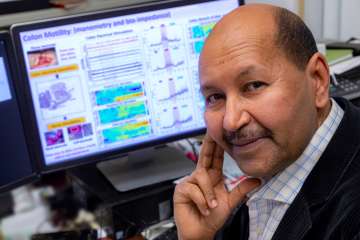
Director, Models of Gastrointestinal Function and Disease (MGFD) Core
CURE: Digestive Diseases Research Center
Professor of Medicine
Vatche and Tamar Manoukian Division of Digestive Diseases
David Geffen School of Medicine at UCLA
Dr. Mulugeta leads research on “pre-clinical neurogastroenterology and motility/translational research.” Specific interest is the gut-brain-gut connection through the study of functional and structural circuitry of the autonomic nervous system to pelvic organs (colon and bladder) and neuromodulation of the autonomic nervous system in health and disease of pelvic organs. These works involve multi-center experts and international teams. Dr. Mulugeta also leads research on the development and use of novel “multi-modality smart pill” and neuromodulation devices and approaches to assess/treat gut secretomotor functions in health and diseases. In addition, he studies the specific role of CRF2 receptors (CRF2R) in stress-related alteration of colonic function and visceral pain. The project tests the hypothesis that CRFR2 activation modulates stress-related neuroenteric physiology and visceral pain of colonic origin. Dr Mulugeta’s works are supported through National Institutes of Health (NIH), National Science Foundation (NSF) and industry grants. Dr Mulugeta teaches ‘Modern Concepts in Physiology” at Integrative Biology & Physiology at UCLA.
Dr. Mulugeta has published several papers on the brain-gut interaction and stress related gastrointestinal motility, pain and inflammatory responses. He is a reviewer for numerous medical journals and serves as editorial board member for the American Journal of Physiology. Dr. Mulugeta serves as a member to several special emphasis panels of NIH to review grant applications. He is recipient of several awards including the 2011 International Foundation for Functional Gastrointestinal Disorders award in basic sciences. Mulugeta Lab
Muriel Larauche, PhD
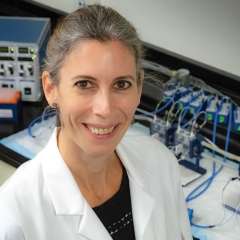
Associate Professor of Medicine
Vatche and Tamar Manoukian Division of Digestive Diseases
David Geffen School of Medicine at UCLA
Dr. Larauche’s primary research focus is to elucidate the mechanisms by which stress influences the brain-gut axis and visceral pain differentially in males and females, as a crucial step toward understanding irritable bowel syndrome (IBS) pathophysiology and improving health care. Her studies place a special emphasis on recruitment of peripheral pathways (enteric nervous system, epithelial permeability, gut neuroimmune system) and the contribution of the corticotropin-releasing factor (CRF) system. In collaboration with Dr. Lin Chang, she has been able to move her preclinical research activities toward translational approaches using biological samples from IBS patients recruited from the community. In parallel, as assistant director of the Division of Digestive Diseases Animal Model Core, her research activities also involve the development of new rodent models of visceral pain and stress. Among her latest achievements, she developed a novel technique to monitor visceral sensitivity in mice and rats non-invasively. With these tools and approaches, she was able to demonstrate for the first time the development of stress-induced visceral analgesia in rodents, which is affected by the technique used for visceral pain monitoring and by a previous exposure to early life stress. More recently, she expanded her research focus to the functional mapping of the autonomic neural circuits to the gut and the pain circuitries of the colon and bladder in porcine models and the impact of vagal and sacral neuromodulation on colonic motility in a model of opioid-induced constipation in pig.
Dr. Larauche has been the recipient of the 2013 Award for Junior Investigator in Basic Science from the International Foundation for Functional Gut Diseases (IFFGD) as well as NIH NIDDK T32, K01 and SBIR awards. She’s currently project leader on a NIH U01 grant led by Dr. Mulugeta. Dr. Larauche’s works include more than 33 original research articles, eight review articles, and four book chapters. She serves as editorial board member of Neurogastroenterology and Motility, Frontiers in Neuroscience (Autonomic Neurosciences), Frontiers in Pharmacology (Gastrointestinal and Hepatic Pharmacology), Frontiers in Physiology (Autonomic Neuroscience) and Frontiers in Pain Research (Abdominal and Pelvic Pain). She is also a member of the Rome V Patient Experience, Gender, Age, Race and Social Determinants of Health Committee. Larauche Lab
Lixin Wang, MD, PhD
Dr. Wang graduated from Peking University Medical School in China, receiving her MS in 1984 and PhD and 1987, as well as teaching human anatomy and neuroanatomy there from 1979 to 1992. She was a visiting scholar in the Department of Histology at Karolinska Institute in Stockholm, Sweden from 1989-1990 and 1992-1993. Dr. Wang joined the UCLA CURE:Digestive Disease Research Center in 1993 and was an associate researcher in the Brain-Gut Interaction Laboratory led by Dr. Yvette Taché at CURE and UCLA up to 2025. She also held the position of research scientist at West Los Angeles VA Medical Center, and principal investigator on a VA rehabilitation grant to assess the beneficial effect of ghrelin agonists in Parkinson’s disease models.
Dr. Wang’s expertise is in neuroanatomy and animal models of brain-gut interaction. She contributed to the treatments of digestive and related dysfunctions of Parkinson’s disease in animal models, and on neuronal tracing of motor and sensory innervation of the colon. She has extensive experience in mapping of brain circuitry involved in brain-gut interactions in animal models of stress, and in neuropeptide- and hormone-regulated feeding and gut motility. Dr. Wang also conducted research on the innervation of epidermis of human skin and hair regrowth induced by a stress hormone antagonist in a mouse chronic stress model. She has co-authored 110 peer-reviewed articles and serves presently as a consultant in the Brain-Gut Interaction Laboratories.
Pu-Qing Yuan, PhD
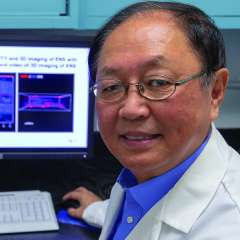
Dr. Yuan received his PhD in neuroendocrinology in 1993 from Peking University Health Science Center in China. After serving as a lecturer and associate professor in the Department of Histology and Embryology at Peking University Health Science Center for two years, he went to Uppsala University in Sweden as a visiting scientist in the Neurobiology Laboratory, Department of Psychiatry (1995-1996) and subsequently moved to UCLA, as a research associate in the Brain-Gut Interaction Laboratories, a position he held up to 2024 where he is presently serving as consultant.
In the lab led by Dr. Yvette Taché, Dr. Yuan has been working in the field of brain-gut interactions, and particularly focusing on the roles of CRF and its three new related peptides, urocortin (Ucn) 1, Ucn2 and Ucn3, in mediating centrally and peripherally stress-related gastrointestinal motor alterations, and on the anti-inflammatory effects of brain-vagal stimulation and ghrelin agonist HM01 on the rat postoperative ileus. He found that CRF is expressed at the gene and protein levels in the rat colon and upregulated by endotoxin. He identified three novel CRF type 1-receptor variants in the rat pituitary, pons and medulla. Dr. Yuan’s work also provided molecular/anatomical support for an important role for CRF/CRF1 coupling in the colon as part of the local effector limb of the CRF1 receptor-mediated colonic motor response to stress. Further, his work established a distribution pattern of CRF2b receptor expression on all three Ucn ligands in the rat gastric and colonic myenteric neurons and their roles in the modulation of the motility and inflammation. He obtained evidence in the rat that abdominal surgery induced a pro-inflammatory M1 macrophage response in the gastric muscular layer that is prevented by central vagal cholinergic activation induced by central TRH or ghrelin agonist HM01. More recently, in collaboration with national and international researchers, Dr. Yuan has been involved in the NIH/SPARC-funded consortium study on comprehensive neuroanatomical and functional mapping of colonic innervation (PI/PD: Dr. Yvette Taché). As a co-investigator, he performed the 3D structure/phenotype and molecular profiling in the mouse, pig and human colon. He developed a CLARITY protocol applicable for 3D imaging/phenotyping of the mouse and pig colon and revealed the ENS 3D structure, connectivity among the enteric plexuses, as well as a rich innervation of the colonic mucosa primarily from the inner submucosa plexus and the distinct patterns of intrinsic cholinergic innervation. Dr Yuan’s works publications include more than 40 original research articles, three review articles, and four book chapters.