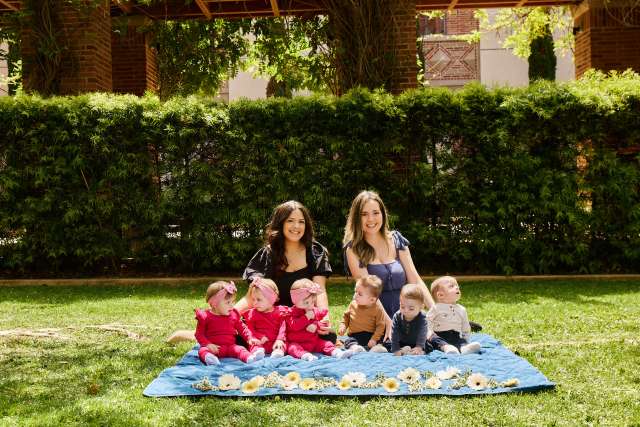
The UCLA Health BirthPlace at UCLA Santa Monica Medical Center had an extraordinary summer in 2025, delivering two sets of identical triplets.
On June 25, Jocelyn Galvez delivered three identical baby girls: Sienna, Rose and Lily.
Then, on Sept. 3, Cristina Lara gave birth to three identical baby boys: Nicolas, Benjamin and Sebastian.
For those who like numbers, consider this: The odds of giving birth to triplets are about one in 8,000 births, whereas the odds of giving birth to identical triplets are about one in 200,000 births.
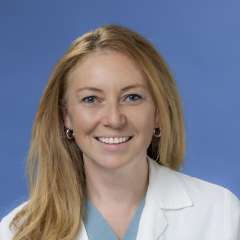
Both sets of triplets were delivered by Ilina Pluym, MD, a Maternal Fetal Medicine obstetrician and gynecologist at UCLA Health and assistant clinical professor of obstetrics and gynecology at the David Geffen School of Medicine at UCLA.
All six babies were born without complications.
While the scenario has never been formally calculated, based on mathematical probability, some estimates put the odds of the same doctor delivering two sets of identical triplets at 40 billion to one, nearly three times the chance of being struck by lightning twice.
“I should play the lottery,” Lara, 36, joked when she heard those odds.
She remembers the first time she saw her three babies, shortly after their birth.
“It was very emotional. Even just lying there and hearing the first cry was so emotional,” Lara recalls. “But seeing all three, it was just wild. I still can’t believe it.”
For Galvez, 28, seeing her babies was “a lot to take in,” she says. “It was unbelievable, because in my eyes, they were perfect. And I couldn’t believe that I made three babies.”
Managing high-risk pregnancies
What distinguishes identical triplet pregnancies from fraternal triplet pregnancies is that all three fetuses share a placenta, the organ that forms in the uterus to deliver oxygen and nutrients to the developing babies.
“When there's one placenta for all three, you can have unequal sharing between all three of them,” says Dr. Pluym, who specializes in high-risk pregnancies. “The moms require more frequent visits, about every one to two weeks for the whole pregnancy, to make sure that they're all growing equally, that they all have an equal distribution of the placental blood flow and that there aren’t any complications.”
Managing the ultrasound is more challenging with identical triplet pregnancies because the doctor must keep track of three fetuses, three umbilical cords and three embryonic sacs, Dr. Pluym says.
Because of the risks associated with sharing one placenta – including stillbirth, fetal growth restriction or umbilical cord compression – identical triplets are usually delivered by Cesarean section at 33 or 34 weeks and can spend weeks in the neonatal intensive care unit.
Identical triplet pregnancies are closely monitored for signs of twin-to-twin transfusion syndrome in which one twin – or triplet – receives unequal blood flow through the placenta and runs the risk of malnourishment and organ failure.
Fortunately, Dr. Pluym says, UCLA Health is well-positioned to manage high-risk pregnancies of all types.
“We have all the top maternal specialists and the fetal subspecialists available to take care of moms with preexisting conditions and fetuses with prematurity or anomalies or complications from multiple gestations,” she says, “as well as state-of-the-art neonatal care once the babies are born.”
Where science and humanity meet
Overseeing high-risk pregnancies is about more than monitoring for complications, says Dr. Pluym. It’s also about providing a human touch.
“It’s holding her hand during the C section, talking to her family, reassuring her that yes, it's going to be overwhelming, but that it will be OK in the end,” she says. She adds that establishing trust with her patients can shape the outcome of pregnancy and delivery.
“I think you really have to see where the patients are coming from,” Dr. Pluym says. “A lot of times patients have their own values, or they have their own fears or their own lived experiences that are going to impact the way they view their pregnancy.
“Asking them, ‘Has anybody in your family ever had a traumatic delivery or traumatic experience? And how does that shape what you want to do?’ is really helpful. I ask them, ‘What is your worst-case scenario, and how can I calm you down about the chances of that happening being exceedingly unlikely?’ ”
Galvez was referred to UCLA Health and Dr. Pluym in the 16th week of her pregnancy and Lara in her 20th week. Both women were first-time moms-to-be, which comes with its own set of fears.
Being pregnant with triplets can compound them.
“I felt very alone because I personally don't know anybody who's had triplets,” Galvez says. “Everyone likes to give you advice because they've been pregnant and had babies, but I just felt like I'm on my own here. Nobody knows what I'm going through.”
Lara found out she was having triplets during her appointment with her gynecologist to confirm the pregnancy.
“As soon as she did the ultrasound, she's like, ‘OK, you're definitely pregnant. I see one,’ ” Lara recalls. “Then she said, ‘wait a minute, there's two … three!’ I'm like, no, you have to be joking. I was lying there and I was freaking out. I'm like, this can't be. It's not possible. My husband was with me, and he was just trying to stay calm. We were both in shock.”
Because of her age, Lara already was flagged as a high-risk pregnancy. Despite her fears about the potential risks, she says she and her husband, Erik, saw the triplets as a gift.
“These were our first kids, and for us to be blessed with three at once and for them to be identical, it was really special,” she says.
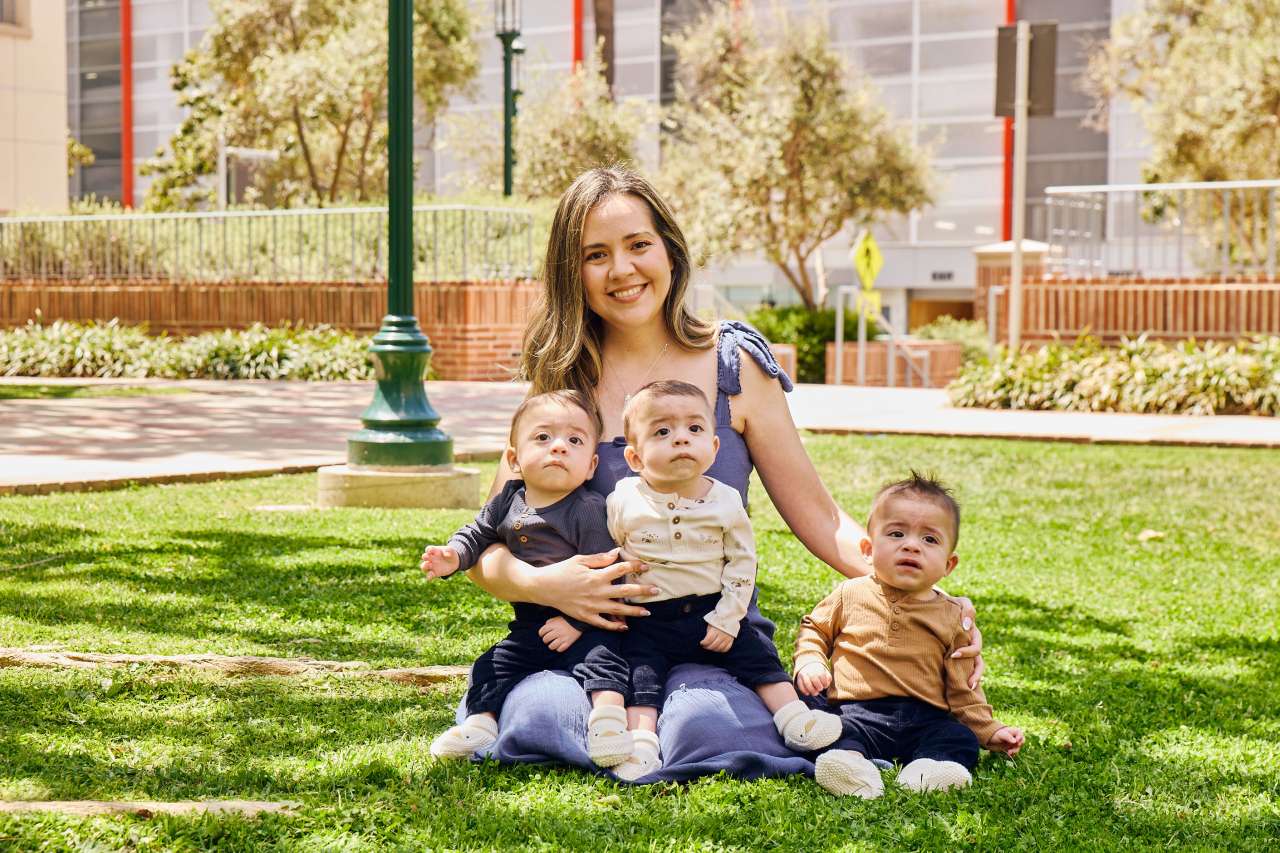
Both women say Dr. Pluym’s transparency, confidence and emotional support were key to alleviating their fears.
“She was very supportive, and she always answered my questions,” Galvez says. “She ended up meeting my fiancé, Nicholas, and my mom, and we all became very close because it was a very unique situation.”
Lara says Dr. Pluym was informative and “in tune with me. She made me feel heard. When I would explain to her what’s going on, she always made me feel calm and that it was completely normal,” she says. “I think that, honestly, is what helped me the most.”
Special deliveries
Because of the potential risks associated with triplet pregnancies, both women delivered at 33 weeks and three days gestation. Both were surprised at how quickly the babies were delivered once surgery began.
As she did throughout their pregnancies, Dr. Pluym alleviated their fears during the procedures, each of which took under an hour.
“I was scared, but again, Dr. Pluym calmed me down,” Lara recalls. She's like, ‘It's very easy. The incision is tiny. It's going to be fast.’ … We got there at 5 in the morning. They took my vitals, they set me up, and by 9:30, I was in the OR, and I was out by maybe 10 o’clock. It was so fast.”
She adds that she and her husband were born at UCLA Health, which made having their triplets delivered there extra special.
What stands out to Galvez was when the surgery was over and another doctor was sewing her up, Dr. Pluym showed her and her fiancé the placenta and pointed to where each baby had been.
“It was the size of a pizza,” Galvez says about the placenta. “It was really dramatic, and it was memorable when she showed me. And then I got a glimpse of my babies, and I was able to meet them, even if it was just for a second.”
Bringing home babies
All six triplets stayed in the NICU until they had gained enough weight to go home. Galvez’s babies, Sienna, Lily and Rose, went home at 20, 24 and 29 days, respectively. Lara’s babies Nicolas and Sebastian went home at almost three weeks; Benjamin stayed an additional week.
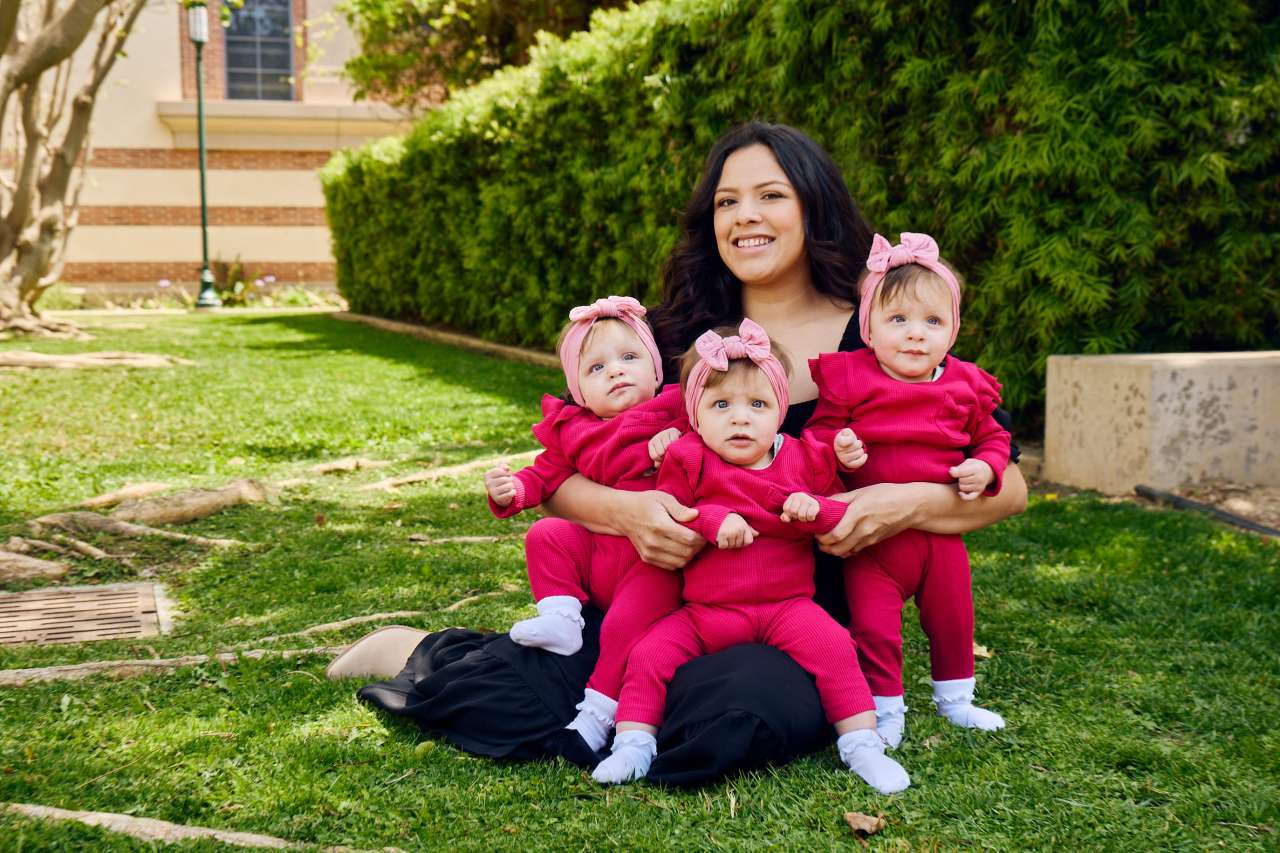
Lara visited her babies in the NICU four hours every day, and her husband would go after work. The nurses were so kind and sweet, she says, and she appreciated the updates she received every morning.
She describes visiting her babies as “very emotional” and remembers getting teary-eyed when she had to leave them.
“But it was kind of a silver lining for me because I actually had time to recover,” she adds. “I went home and I was able to rest, or semi-rest, because the next day I went back to the hospital to be with them. But I did take time to sleep, so I think that helped me a lot because a lot of moms go home with their newborns, and they don’t get time to rest.”
Galvez remembers the excitement of bringing home the first baby, Sienna, at 20 days.
“It was fun to have one,” she says, “and once we picked up the second one, that’s when it got harder. And then we picked up the third baby, and at that point I was super sleep deprived. It was really challenging going from one to two and then going to pick up a third baby, and you just don’t know how you’re going to do it, but you do it.”
A new normal
Today, the moms report all six triplets are thriving and are meeting their milestones despite the early deliveries.
Says Galvez: “They're still on the smaller end because they were born basically two months early, but they're healthy, they're happy. They're great babies. Every single day, I think, ‘I cannot believe that this is my life.’ I feel so blessed just because I love them, and they're amazing.”
Lara echoes those feelings.
“At first, they would hardly sleep and neither would we,” she recalls. “But now it's just a breeze. We know each other. We have our routine down, and the boys are sleeping and they're eating and they're happy, and it's just fun and games all day.”
She adds that the experience of having triplets has given her an inner strength she didn’t know she possessed.
“When I was pregnant, I would ask myself, ‘How am I going to do this? This is going to be really hard,’ ” Lara recalls. “But after having them and having all three home with me, it’s like this additional strength kicked in. And seeing them smile and being able to produce enough milk for all three gives me strength to say, ‘OK, I’m doing great.’ And that gives me the strength and energy to keep going.”