Investigators at the UCLA Health Jonsson Comprehensive Cancer Center are testing a promising new treatment strategy designed to deliver chemotherapy more precisely to ovarian cancer cells while potentially reducing side effects.
Known as antibody-drug conjugates, or ADCs, the approach uses engineered antibodies to identify specific proteins on tumor cells and deliver powerful chemotherapy directly to the cancer. By combining targeted delivery with potent anti-cancer drugs, researchers hope to improve outcomes while sparing healthy tissue from unnecessary toxicity.
The strategy is now being tested in two new clinical trials at UCLA, where investigators are evaluating whether these therapies can be used earlier in treatment, before surgery, in patients newly diagnosed with ovarian cancer.
“These drugs are really changing clinical practice,” said Gottfried Konecny, MD, a medical oncologist at UCLA Health and professor of hematology/oncology at the David Geffen School of Medicine at UCLA. “They’re moving very quickly from being a last-line option into earlier lines of therapy, where they may have the greatest impact.”
Building on early clinical trial success
The new trials build on years of clinical research at UCLA demonstrating the potential of ADCs in ovarian and other cancers. The UCLA team has played a critical role in developing ADCs for ovarian cancer by participating in some of the earliest clinical trials.
In 2022, the Food and Drug Administration approved mirvetuximab soravtansine, the first ADC specifically for ovarian cancer. The drug targets a protein called folate receptor alpha, which appears at high levels on many ovarian cancer cells.
In a large international clinical trial known as MIRASOL, where UCLA was the top enrolling center in the United States, patients receiving the targeted therapy lived longer than those given conventional chemotherapy and experienced fewer severe side effects.
The results helped establish ADCs as one of the most promising new treatment approaches for ovarian cancer.
Researchers are now trying to expand that strategy by identifying other proteins that could serve as targets. One promising candidate is claudin-6, a protein found in many ovarian tumors but largely absent from normal adult tissues.
In an early-stage clinical study presented at ESMO in 2024, a claudin-6-targeted ADC developed at UCLA known as ixotatug vedotin, produced encouraging responses in patients with advanced ovarian cancer whose disease had already resisted multiple treatments.
Among patients with claudin-6-positive tumors and platinum-resistant disease, roughly half experienced tumor shrinkage.
“These are patients who have exhausted many options,” Dr. Konecny said. “Seeing those kinds of responses is very promising.”
The next question, researchers say, is whether these drugs could work even better if used earlier in treatment.
Two trials, two tumor targets
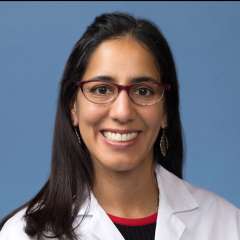
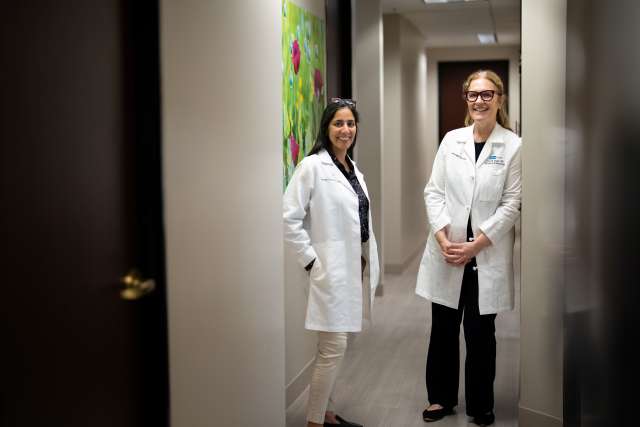
The first trial, called CATALINA-4, will test the safety and efficacy of ixotatug vedotin with chemotherapy given before surgery in patients whose tumors express the claudin-6 protein. The study is led by gynecologic oncologist Ritu Salani, MD, director of the Division of Gynecologic Oncology at the David Geffen School of Medicine at UCLA.
“Our best opportunity to cure patients is in the frontline setting and we are looking for ways to make treatment more effective from the very beginning,” said Dr. Salani. “By testing tumors to allow for directed and targeted therapies earlier, we hope to improve how patients respond before surgery and ultimately achieve better outcomes.”
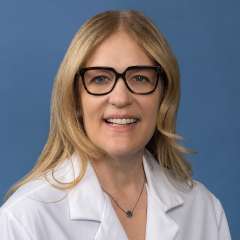
The second trial is led by Dana Chase, MD, professor of clinical obstetrics and gynecology in the division of gynecologic oncology, and will evaluate an ADC that targets the folate receptor, building on the success of mirvetuximab and exploring whether similar therapies can be used earlier in the course of the disease.
“These therapies allow us to better personalize treatment based on the biology of each patient’s tumor,” Dr. Chase said. “The goal is to move beyond a one-size-fits-all approach and offer more precise options that can improve both effectiveness and quality of life.”
The trials complement each other because patients typically express one protein or the other, Dr. Konecny said. About half of ovarian cancers express claudin-6, and roughly a third express the folate receptor.
Together, the trials could make targeted therapy available to a large portion of women newly diagnosed with the disease. That shift could ultimately improve long-term outcomes for patients.
“If we can translate this higher efficacy into the frontline setting,” Dr. Konecny said, “there’s a higher chance, potentially, for a cure.”
Individuals interested in participating in the CATALINA-4 trial can contact Alexis Alvarado at [email protected]. Those interested in the mirvetuximab study can contact Heather Leatherwood at [email protected].