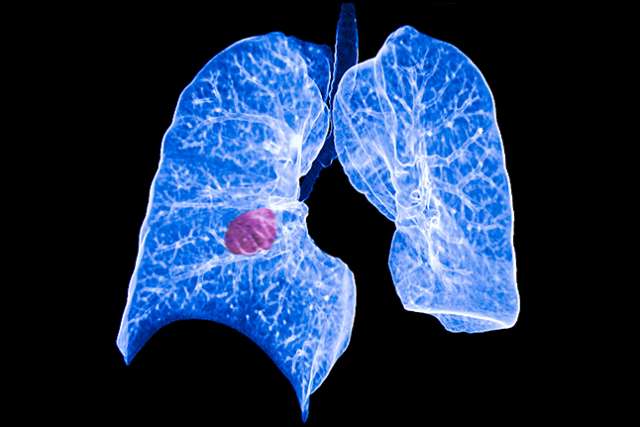
A study led by researchers at the UCLA Health Jonsson Comprehensive Cancer Center found that a dietary form of a naturally occurring molecule called calcium alpha-ketoglutarate, or Ca-αKG, reduced lung tumor growth in female mice and activated genes associated with better outcomes in women with lung cancer. The researchers also found that Ca-αKG had the opposite effect in male mice, where it was associated with larger tumors and increased tumor-cell proliferation.
The findings, published in the journal Cell Reports, suggest that Ca-αKG may influence lung cancer primarily through epigenetic changes, chemical modifications that help control which genes are turned on or off, rather than by changing the cancer cells' basic energy metabolism. The study highlights the importance of considering biological sex and tumor genetics when developing metabolic approaches to cancer prevention and treatment.
“These findings offer a glimpse into the complicated relationship among metabolism, cancer and biological sex,” said Dr. Claudio Scafoglio, associate professor of pulmonary and critical care medicine at UCLA and senior author of the study. “The fact that we observed opposite responses in male and female mice underscores the importance of understanding how sex and tumor genetics shape the response to these types of interventions.”
Lung cancer remains the leading cause of cancer-related death worldwide, and lung adenocarcinoma accounts for a large proportion of cases. Although targeted therapies and immunotherapies have improved outcomes for some patients, researchers continue to search for new approaches to prevent or slow the disease.
One growing area of research focuses on how metabolism influences cancer. Some metabolic molecules also affect the epigenome, the system of chemical modifications that controls how genes are expressed.
Alpha-ketoglutarate, or αKG, is a naturally occurring molecule involved in the tricarboxylic acid cycle, a series of reactions that helps cells generate energy. It also acts as a cofactor for enzymes involved in epigenetic regulation, including enzymes that remove methyl groups from histones and other proteins. However, how increasing αKG affects lung tumor growth in living organisms has remained poorly understood.
To investigate this, the researchers used mice genetically engineered to develop lung adenocarcinoma driven by a mutation in KRAS, one of the most common cancer-driving genes in lung adenocarcinoma. The mice were given either a control diet or a diet containing 2% Ca-αKG for 16 weeks.
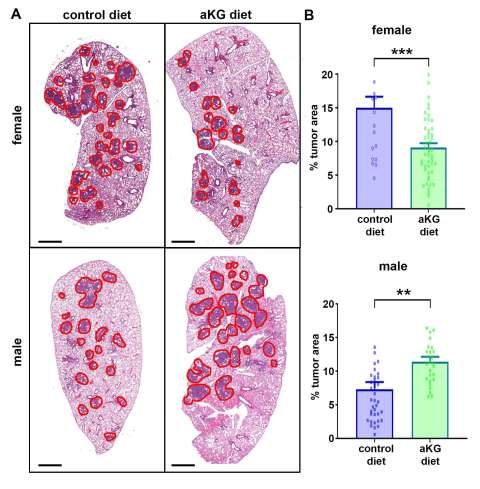
The researchers found that female mice receiving Ca-αKG had significantly smaller tumors and lower levels of tumor-cell proliferation compared with mice receiving the control diet. In contrast, male mice receiving Ca-αKG developed larger tumors and had higher levels of tumor-cell proliferation.
The number of tumors did not change significantly in either sex, suggesting that Ca-αKG primarily affected tumor growth rather than tumor formation.
The researchers next looked at how Ca-αKG changed the molecular characteristics of the tumors. In female tumors, the supplement reduced two repressive histone modifications, H3K27me3 and H3K9me3, which can limit the activity of certain genes. In male tumors, Ca-αKG instead increased H3K27me3, suggesting that the supplement produced opposing epigenetic effects in the two sexes.
Gene-expression analysis provided further evidence of these differences. In female tumors, Ca-αKG activated a group of genes associated with myogenesis, or muscle development. These genes are normally associated with cardiac or skeletal muscle cells and are rarely expressed in epithelial tumors. The same gene program was suppressed in male tumors.
One potential regulator of this response was TBX5, a transcription factor involved in regulating cell identity and development. Ca-αKG increased TBX5 protein levels in female tumors, while laboratory experiments showed that an alpha-ketoglutarate derivative also increased TBX5 expression in human lung cancer cells derived from female patients.
To explore the potential relevance of TBX5 in human lung cancer, the researchers analyzed data from The Cancer Genome Atlas. They found that TBX5 expression was higher in tumors from women and was associated with better five-year overall survival among female patients. Higher TBX5 levels were also associated with lower expression of genes involved in tumor-cell proliferation and higher expression of genes associated with a more differentiated tumor state.
The researchers cautioned, however, that the human analysis was observational. The patients were not treated with Ca-αKG, so the findings do not demonstrate that the supplement increases TBX5 or improves survival in people.
The researchers also found that the effects of Ca-αKG depended on the genetic makeup of the tumor. When they tested the supplement in mice with KRAS-driven lung cancer that also lacked the tumor-suppressor gene TP53, Ca-αKG no longer significantly reduced tumor growth. In human lung adenocarcinoma, tumors with mutated TP53 also had lower TBX5 expression, further suggesting that tumor genotype may influence the relationship between Ca-αKG, TBX5 and tumor growth.
The researchers do not yet know why Ca-αKG increased tumor growth in male mice. When they repeated the experiment in a different mouse genetic background, Ca-αKG did not increase tumor burden in males, suggesting that the response may also depend on genetic background.
“These findings highlight how a metabolic intervention can have broad effects on the cancer genome, not only by changing the energetic state of cancer cells, but also by directly affecting gene regulation. Cellular metabolism is tightly linked to epigenetic state via a complex network of interdependent pathways. This study is an early step toward the full characterization of metabolic and epigenetic modifications induced by nutritional interventions,” said Scafoglio.
Future studies will be needed to determine why the response differs by sex and tumor genotype and whether these findings could eventually inform strategies for lung cancer prevention.
The study’s first author is Martin Alcaraz Jr., a postdoctoral scientist at the UCLA Health Jonsson Comprehensive Cancer Center. Other authors, all from UCLA, are Aparamita Pandey, Mia Santiago, Camelia Dumitras, Leilani Pradis, Estefany Gomez, Adriana Soto, Pasquale Saggese, Abigail Krall, Bin Liu, Heather Christofk, Steven Dubinett and Xue Li.