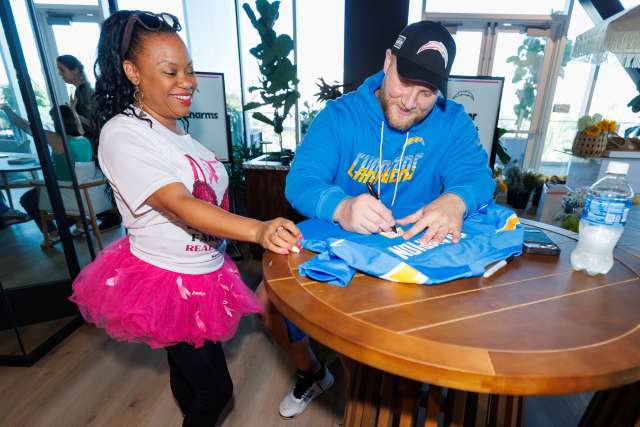
For Carol Carr, 63, the best thing about the annual Los Angeles Chargers Crucial Catch event for breast cancer survivors wasn’t the make-your-own bouquet station, the candle-making bar, the gourmet lunch or the team swag.
It was the chance to connect with fellow cancer survivors.
“It’s like a reunion for us,” said Carr, sitting beside Tina Pagilagan, 46, whom she met at a Crucial Catch event nearly eight years ago.
“We were both coming right off chemo,” Carr said, “and now we’ve been kind of inseparable ever since.”
The two women live three hours apart, so they stay in touch by phone and social media, “and every year, we like seeing each other at these events,” Pagilagan said.
The two were making bag charms with beads and strips of fabric. Carr fastened hers to a monogrammed Chargers tote bag she received at the Oct. 5 event at The Bolt, the Chargers practice facility in El Segundo. The day also included personalized Chargers jerseys for survivors and a game of bingo hosted by team center Tyler Biadasz, who signed autographs and posed for photos with fans.
The gathering was part of the National Football League’s Crucial Catch initiative, a partnership with the American Cancer Society to support cancer prevention and early detection. UCLA Health has been the Chargers’ official medical partner since 2024.
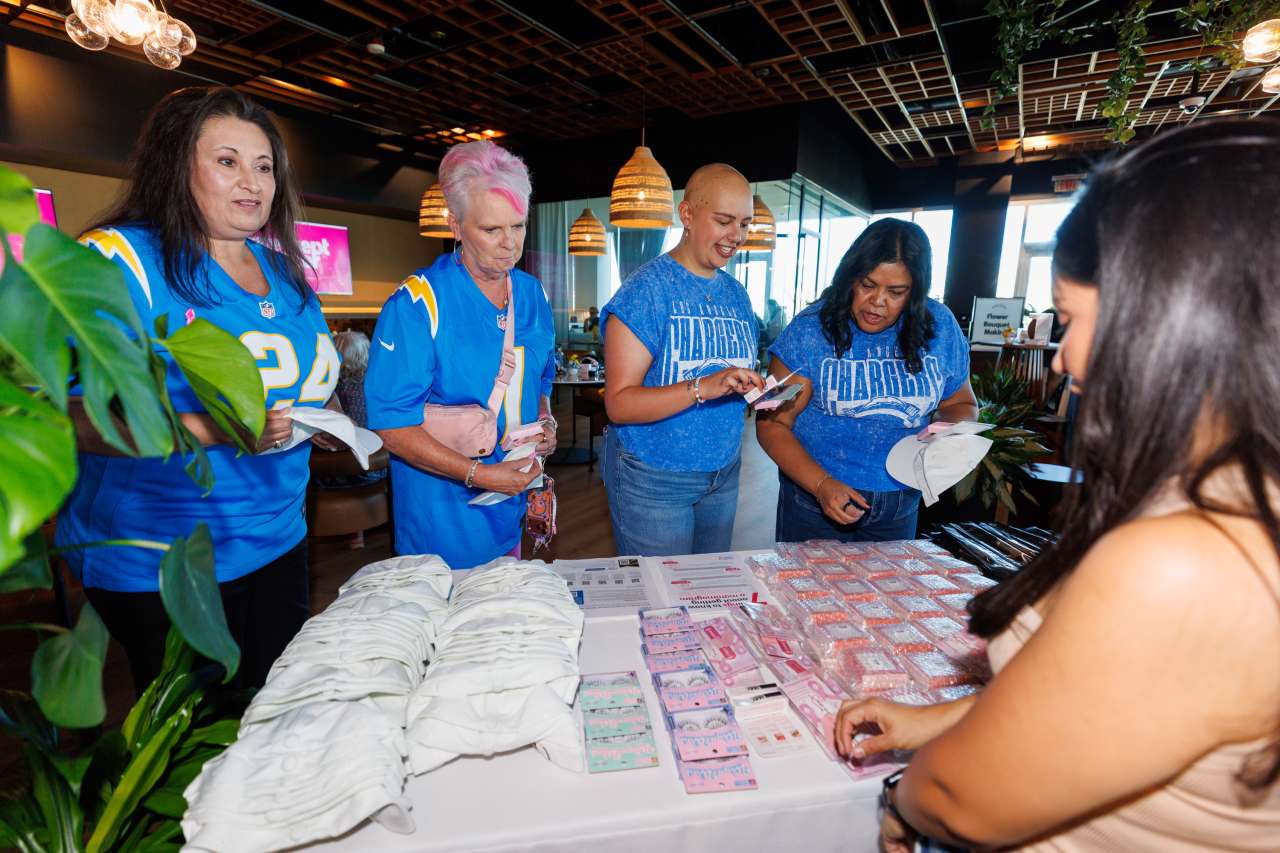
“Crucial Catch is a very important effort that’s put forth by the NFL,” Chargers chairman and owner Dean Spanos told guests. “It raises a lot of money for research and development and everything for cancer.”
His wife, Susie Spanos, helped launch the initiative after her own breast cancer diagnosis. Since 2009, it has raised more than $38 million to support access to cancer screenings across the country.
The Chargers will also honor breast cancer survivors at the team’s Oct. 11 game against the Denver Broncos.
Finding a community
Lauren Dennis and her mom, Myra Gutierrez, first came to a Crucial Catch event two years ago, after Dennis was diagnosed at age 24.
“What we called it two years ago was the silver lining of this experience,” said Dennis, who turns 27 on Oct. 8. “So as much as it sucks to be here under these circumstances, it’s amazing to be recognized in this sort of way, and we’re making sure that the future is more aware of the situation — that it can happen to anyone.”
There’s no history of breast cancer in their family, and mammograms aren’t typically recommended until age 40. Gutierrez credited UCLA Health oncologist Diane Prager, MD, for helping advocate for Dennis’ care.
Dennis said she enjoyed making candles and assembling her own flower bouquet, but the most powerful aspect of the event was connecting with other women.
“It’s incredible just to feel like you’re not so alone in the process,” she said. “When you’re trying to build a life for yourself and you get hit with this, it’s like: OK, where do I go from here? I feel so alone. But, unfortunately and fortunately, there’s a community that’s out there.”
Importance of early detection
Tasha Champion has been passionate about spreading the word about early detection and genetic testing since her mother, Priscilla Roberts, discovered 10 years ago that she carries the BRCA 1 gene mutation, which more than quadruples the risk of breast cancer compared to the general population. Both are regular Crucial Catch guests.
Roberts was diagnosed in 1999. Based on her family history of the disease, her UCLA Health doctor encouraged her to get tested for the BRCA gene. Roberts’ four children were subsequently tested and learned they carry it, too.
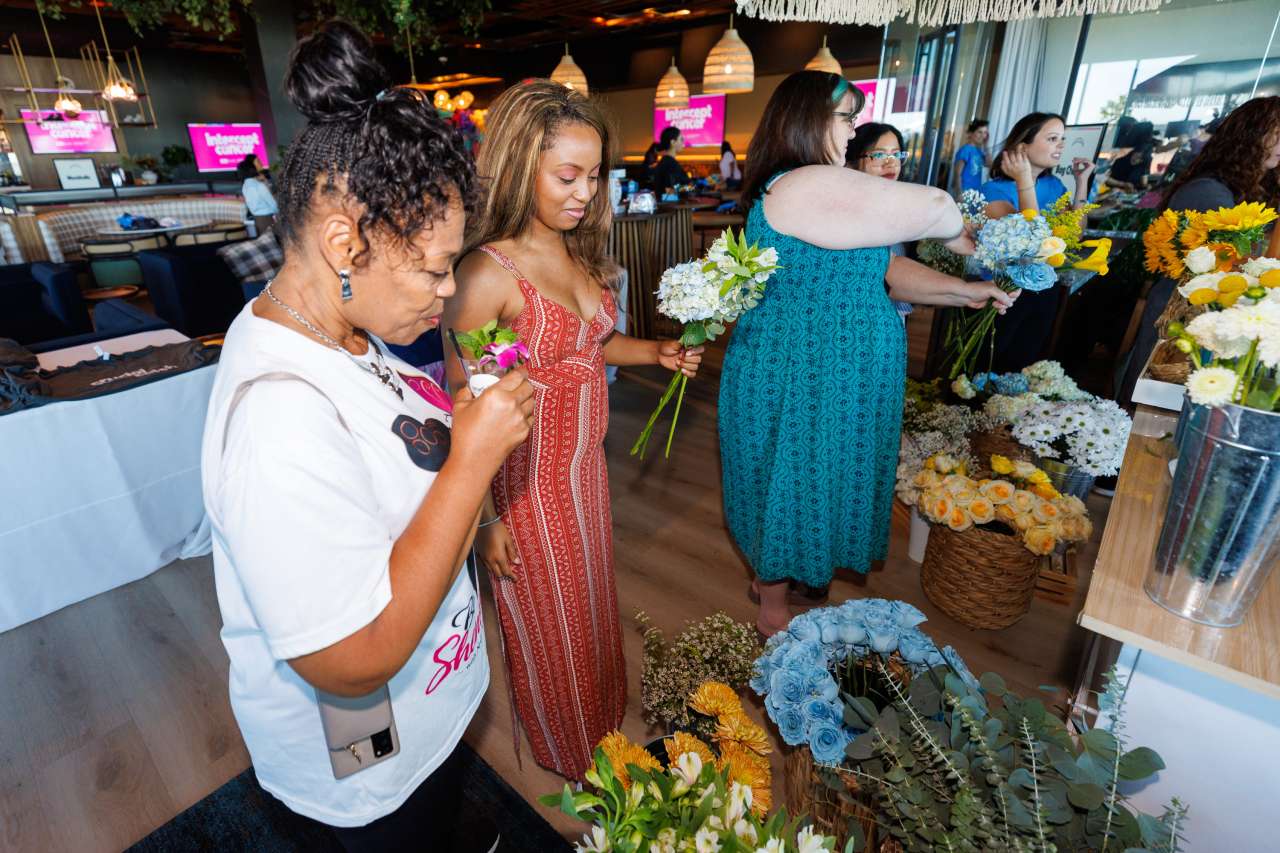
Champion and one of her sisters elected to get preventive double mastectomies. Doctors found cancer in both women during the procedure, despite each having received normal mammogram results just six months prior.
“I went into the hospital to become a pre-vivor, and I walked out of that hospital a breast cancer survivor,” Champion said.
Since then, Champion has worked with the American Cancer Society, local media outlets, Pfizer and her own Shenomenal Foundation to encourage women to know their family history, get preventive screenings and talk openly about cancer with loved ones.
“When you get it out, you allow other people to love on you, to pray for you, to show up for you, and that can really make the difference in how you personally handle it,” she said.
Shared experiences
Back at the bag-charm-making session, seven-and-a-half-year survivor Brenda Marcil, 54, discovered that being with other cancer survivors can be powerful in unexpected ways, like when she mentioned that her hands hurt as she strung the fabric pieces through a keyring.
“I was thinking, well, it’s just a me thing that my hands hurt,” said Marcil, sitting near Carr and Pagilagan. “And they were like, ‘No, that’s a normal thing. Hands hurt, body hurts.’
“It feels really nice that we can all kind of talk about certain things and maybe chuckle a little bit, like ‘Oh yeah, that’s me. That’s me, as well.’ And it does feel like a community, which feels wonderful.”