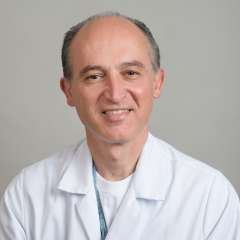
During a casual dinner about a decade ago, Abbas Ardehali, MD, grabbed a paper napkin and began to draw. The cardiothoracic surgeon wanted to show his wife, Mitra Ardehali, DDS, his new idea for how to improve the odds for patients on life support.
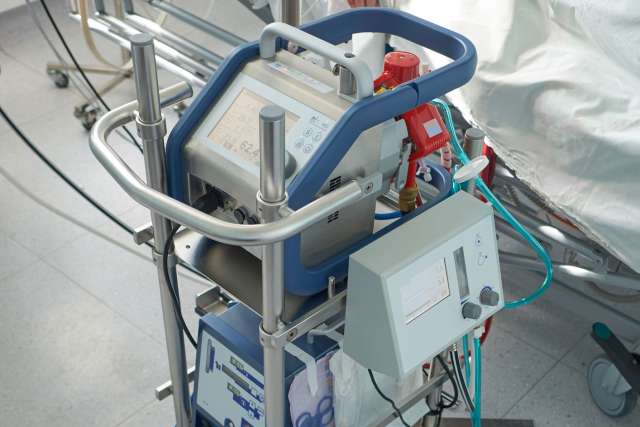
The simple, Y-shaped sketch eventually became the Quantum Dual Lumen Cannula, a medical device that has transformed extracorporeal membrane oxygenation. ECMO is the technology that keeps patients with failing hearts or lungs alive while waiting for a transplant.
“The Quantum actually maintains the patient in the most physiologic condition,” said Dr. Ardehali, director of the UCLA Health Heart and Lung Transplant Program.
Dr. Ardehali took home the paper napkin with his drawing and held onto it for a while. He then worked with the UCLA Technology Development Group to create a patented prototype device. After extensive testing, it was licensed to a manufacturer and then approved by the FDA in 2021.
On ECMO, the patient’s blood is pumped into a machine that removes carbon dioxide and returns oxygen-filled blood back into the patient’s body. The Quantum mediates that process much more efficiently.
“Many other technologies were mixing the oxygenated and deoxygenated blood together,” said Dr. Ardehali, also a professor of surgery and medicine in the David Geffen School of Medicine at UCLA. “That's why patients couldn’t walk and were generally exhausted. With this, it removes the deoxygenated blood completely.”
The device has other advantages as well. Connecting a patient to ECMO was previously a very invasive procedure. The Quantum has a single site of insertion into the right side of the neck.
This reduces complications such as bleeding and developing clots, according to Dr. Ardehali.
“We have found that patients can be on ECMO with this device for weeks and months,” he said, “yet still be in the best shape going into a transplant.”
That innovation has not been limited to UCLA Health. When he attends medical conferences, Dr. Ardehali said that more than a few fellow surgeons have brought up the Quantum as a game-changing improvement in their patients’ care.
“Personally, it's very gratifying,” he said, “to tell them that I was the one who invented this. But the reality is that this would not have been possible without an institution like UCLA and federal support.”
Dr. Ardehali emphasized that the Quantum was developed because of research dollars from the National Institutes of Health, coupled with continuous support from the medical school.
“It's a tribute to the collaboration between a public research institution and the federal government,” he said, “and the visionary leadership that have made the Quantum possible, to save lives.”