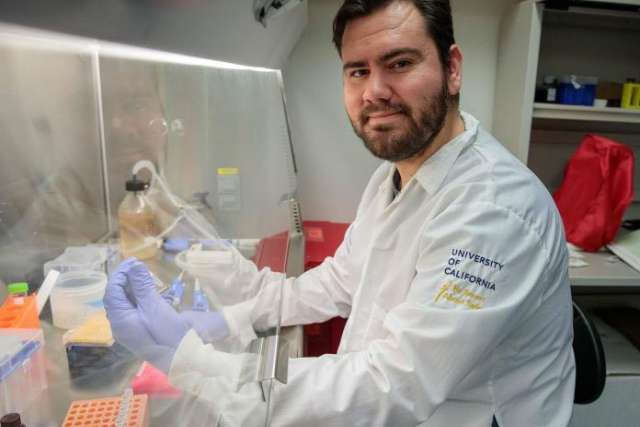
Gustavo Garcia Jr., 33, is a first-year medical student at the David Geffen School of Medicine at UCLA, yet he’s already contributed significant research into the prevention of the Zika virus, hemorrhagic fever viruses and coronavirus.
He’s also co-founded, along with UCLA professor Vaithi Arumugaswami, DVM, PhD, and Sanjay J. Chauhan, MD, a biotech company called Veergen Inc., which is located in the Magnify incubator at the California NanoSystems Institute at UCLA. Veergen Inc. is focused on vaccines to prevent outbreaks of viral diseases.
Garcia’s fascination with infectious diseases and immunology began after his own close encounter with a virus as a teenager.
He was 15, living with his family in Gardena, California, when he began experiencing severe headaches, which made his wrestling practices difficult. The headaches became so bad that he began forgetting things, such as where he’d put his wallet. As his symptoms worsened — his neck was so stiff he could barely turn his head, and he became tired and feverish — Garcia’s parents took him to a nearby emergency department, where he was diagnosed with viral meningitis.
He was in the hospital for a week. “I started asking the doctor, how did this happen? How did I catch this, whatever it was?” Garcia says. “And he said, ‘You know, this virus could affect someone else completely differently. They might just have like a minor cough, but in your case, you had a severe reaction to it.’ I couldn't comprehend that. And that made me very curious about how these different pathogens or microbes work.”
It took several more weeks at home before Garcia fully recovered. From that moment, Garcia’s interest in biology and the immune system grew. He began volunteering at the hospital where he’d recovered. “I knew I wanted to go into medicine,” he said. He set his goal on getting into college, even though schoolwork did not come easy to him, and no one in his family had gone to college.
He attended El Camino College in Torrance, leading to his next big step: “I was able to transfer to UC Berkeley,” he says.
Studying molecular and cell biology
At UC Berkeley, Garcia majored in molecular and cell biology with an emphasis on immunology and disease pathogenesis.
It was there, he says, that his eyes were opened to the deep knowledge that comes from basic research, and he wanted to join a lab. He participated in the Biology Scholars Program, which helps expand access and equity in STEM by supporting students from diverse backgrounds, including those who are historically underrepresented in the sciences, work toward their goals in medicine or science.
Through that program, Garcia obtained a summer research internship in the lab of Dr. Shauna Somerville, a faculty member at UC Berkeley in the department of plant and microbial biology. He presented a research project at a national conference while in that lab.
Garcia’s studies and world events suddenly came together when the West Africa Ebola virus epidemic broke out in 2013.
“It was amazing because the faculty were using their actual research to help us understand the concepts and using real world examples of what was happening to help us see the importance of what we’re doing,” he said. “I had a little experience with viruses, and that really caught my attention.”
Following that came a devastating Zika virus outbreak.
“I was really intrigued by how these very small pathogens can cause so much disease in humans and have such an impact,” Garcia says. “And I was also very captivated by how scientists were quickly working to understand it.”
As he neared graduation from UC Berkeley, Garcia joined the lab of UCLA faculty Dr. Arumugaswami, where he worked for several years.
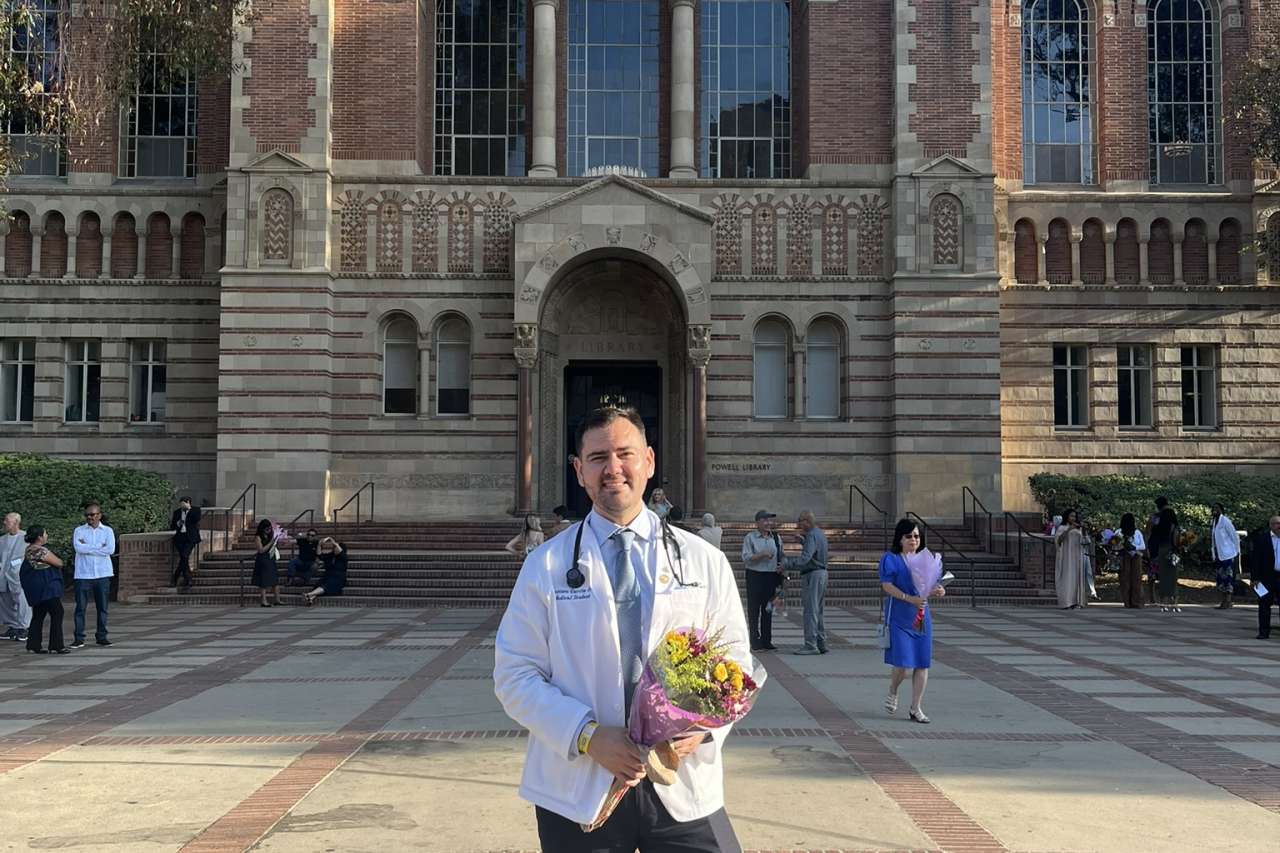
Here his goals became more focused. “I knew I wanted to do something where I can see patients and also have the ability to lead cutting-edge research to develop new therapies to treat those patients,” says Garcia.
One of his early projects was to create a safe and modified viral system that led to vaccine development for the Zika virus.
Arrival of the coronavirus
Just as Garcia was preparing to apply to medical school, he and his colleagues began hearing about the coronavirus. “We felt like this was the moment where we can really use our technical expertise and be ready for a response,” he says.
Their team joined the intense global effort to identify a COVID-19 vaccine.
“Within a few months, in early 2020, we were able to download the sequence of COVID-19 and start doing our own research — it was really fast,” he said.
Garcia, Dr. Arumugaswami and their team were intensely focused on 16 to 20 projects at the same time, working with collaborators around the world.
The vast potential benefit of medical research for current and future generations inspired Garcia. “All that information that came out of all the work can help develop new therapies for future responses,” he says. Garcia was motivated by the reality that certain communities were affected by COVID-19 disproportionately, he said.
Co-founding Veergen Inc. was a logical step. The start-up’s mission is to develop vaccines that will prevent viral disease outbreaks around the world.
“We realized we could actually develop a company and take the basic science into product development,” says Garcia. “These would be life-saving treatments that come from a synergy between academia and industry.”
This experience solidified Garcia’s aspiration to pursue a career as a physician-scientist, one that allows him to care for patients while also developing new, life-saving therapies.
As the pandemic began to ebb, he applied to the David Geffen School of Medicine, where he is now in his first year. He is part of UCLA’s PRIME-LA program, which awards both a medical degree and a complementary master’s degree designed to develop physician leaders and advocates dedicated to serving California’s communities.
In his spare time, of which there is very little, Garcia says he enjoys listening to live music and traveling. “It’s good to be curious about the world, and exercise that adventurous spirit we all have,” he says.