
What's New in the Treatment of Atrial Fibrillation
What's New in the Treatment of Atrial Fibrillation
Pulsed Field Ablation
Background
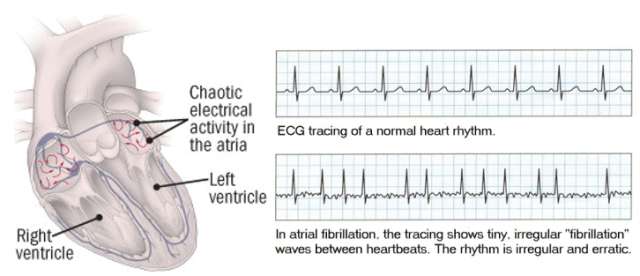
Atrial fibrillation (AF) is the most common sustained arrhythmia and can carry a significant symptomatic burden and up to a six-fold increase in the risk of stroke. AF is a chaotic, rapid, irregular atrial rhythm often originating from the left atrium or from previous surgical scars. The chaotic nature of electrical signals (see Figure 1) and “fibrillating” of the upper chambers (atria) during AF results in incomplete emptying of blood and risk of clot formation in the recesses of the upper chamber. For this reason, clot prevention is the cornerstone of treatment for atrial fibrillation, since clots forming in the heart can result in a stroke and in some cases, death.
The other arm of acute pharmacologic management for AF is aimed at slowing the heart rate, since a racing pulse is the primary cause of symptoms, typically shortness of breath. AF can present intermittently in some people and persistently in others.
In atrial fibrillation, the tracing shows tiny, irregular “fibrillation” waves between heartbeats. The rhythm is irregular and erratic.
The most common risk factor for AF is advancing age, with an overall lifetime risk in the general population between 20% and 40%. There are also many modifiable risk factors such as smoking, alcohol, obesity and a sedentary lifestyle. Some conditions are associated with a higher risk for AF, such as hypertension, obstructive sleep apnea and diabetes, and AF is known to be hereditary. Importantly, adults with congenital heart disease face a five to 10 times higher risk for AF than the general population, often occurring 30 years earlier, believed to be related to previous surgical scarring and hemodynamic stress. This makes recognizing and eliminating AF essential in the care of adults with congenital heart disease.
Smartphone-based ECG monitoring (Kardia Mobile) and Wearable ECG monitoring (smart watch, fitness trackers) have the potential to facilitate recognition of AF and can empower individuals to take a more active role in monitoring their health. Medically supervised diagnostic testing includes a 12-lead ECG, Holter monitoring, patch monitoring or implantable loop monitoring. Depending on the degree of suspicion for AF and the frequency and duration of AF, the appropriate type of medical monitoring can be selected.
Treatment
Clinical management of AF has evolved over the past two decades, favoring catheter-based technology over pharmacologic arrhythmia management. Despite the treatment strategy selected, curing AF has proven to be elusive, and temporary suppression comes with the potential for future recurrence and the short-term risk of stroke.
Catheter-based treatment for AF emerged in the first decade of this century. Radiofrequency ablation was FDA approved in 2008, using heat generated by radio waves at the tip of specialized catheters to destroy targeted cardiac tissue and interrupt the electrical focus for AF. Cryoablation was subsequently FDA approved in 2010, using cold energy to freeze targeted tissue with similar success rates to radiofrequency ablation. ECG tracing of a normal heart rhythm. Chaotic electrical activity in the atria Left ventricle In atrial fibrillation, the tracing shows tiny, irregular “fibrillation” waves between heartbeats. The rhythm is irregular and erratic.
These two catheter-based therapies have been the mainstay for AF, with the downsides including longer procedure times under general anesthesia and the potential for surrounding tissue injury. This risk of damaging neighboring structures is low, but the consequences are significant in the setting of phrenic nerve injury, esophageal injury or pulmonary vein scarring and obstruction.
Pulsed Field Ablation
New ablation technology has focused on reducing the risk to surrounding structures through more selective tissue destruction and reducing procedure length, anesthesia exposure and recovery time. Pulsed Field Ablation is the newest FDA-approved (2024) catheter-based therapy for AF and will likely replace radio-frequency and cryoablation as the first nonthermal catheter-based treatment. Pulsed field ablation uses rapid, high-frequency electrical pulses to create microscopic holes in the cells, with less damage to neighboring structures, shorter procedure times and the potential for longer lasting results. This type of ablation is also being used to treat atrial flutter, a more organized arrhythmia that is common in ACHD due to atrial scars from previous cardiac surgery.
NOTE: UCLA Health is a participating center in an international multicenter trial investigating pulsed field ablation in congenital heart disease.