
Training Support
Neonatology Division Conferences
- Topics Conference
- Case Conference
- Journal Club
- Morbidity and Mortality Conference
- Neonatology-Pathology Conference
- Fetal and Neonatal Care Conference
- Joint Pediatric Surgery and Neonatology Conference
All Pediatric Fellows will participate in the Department of Pediatrics Core Curriculum which includes monthly Topics Conferences and Pediatric Fellows College that meets twice a year for half day. Teaching sessions include topics to help fine tune skills for scholarly and clinical work and life after fellowship.
Topics include:
- Finding a Research Mentor
- Clinical and Laboratory Research Methodology and Study Design
- Various Career Paths
- CV Preparation
- Job Search and Negotiation
- Scientific Dissemination
- Manuscript and Grant Writing
- Scholarly Work in Clinical Settings (QI initiatives)
- Ethics
- Biostatistics
- Communication Skills/Difficult Situations
- Effective Teaching Methods for all Learners
- Equity in Health Care Delivery
- Life/Work Balance and Well-Being
In addition, The Children’s Discovery and Innovation Institute (CDI) (uclahealth.org/departments/pediatrics/cdi/seminars-symposiums) offers monthly talks/seminars on various topics in pediatric health.
Fellows Education
- Fellows Core Conference
- Respiratory Physiology Curriculum
- Cardiology Physiology Curriculum
Elective Rotations & Specialized Training
Fellows have access to a diverse range of electives and rotations designed to enhance and complement core NICU training:
- Cardiothoracic Intensive Care Unit (CTICU)
- Pain Management and Palliative Care
- Advanced Imaging (Radiology and Cardiology)
- Maternal–Fetal Medicine
- Global Health
- Anesthesiology
- Antenatal Counseling
These experiences provide fellows with broader clinical perspective, multidisciplinary collaboration, and advanced skills relevant to complex neonatal care.
Wellness & Well-Being Support
We are committed to supporting the personal and professional well-being of our fellows. Training in neonatology is deeply meaningful and can also be emotionally and physically demanding — our program prioritizes a culture of support, balance, and resilience.
Fellows have access to a wide range of institutional wellness resources, including:
- UCLA Well-Being Policy
- UCLA Health Physician and Faculty Wellness Program
- UCLA Integrative Medicine
- UCLA Resident and Fellow Benefits
- Fatigue Mitigation Transportation Program
- UCLA GME Leave Policy
- Ginger: Virtual Therapy and Psychiatry
- UCLA Psychological and Mental Health Services
- Behavioral Wellness Center
- UCLA Mindful Awareness Research Center
- Salary and Benefits
Neonatal Perinatal Simulation Program
Simulation training is a mainstream educational method for residency and fellowship trainees. The Accreditation Council for Graduate Medical Education has included simulation as part of its recommended core didactic activities for residents and fellows. In partnership with the cutting-edge UCLA Simulation Center, we have created the neonatal-perinatal fellowship simulation program, which was inaugurated in July 2017.
The simulation training begins during orientation of first year fellows and continues throughout their fellowship. Trainees learn to actively apply and incorporate knowledge and cognitive functions in specific crisis management scenarios.
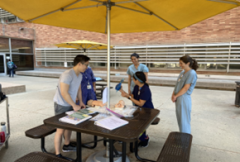
The objectives of the neonatal perinatal fellowship simulation program include:
- Integrate cognitive, behavioral, technical skills and critical thinking in dynamic, evolving crisis management scenarios
- Develop leadership skills in the NICU and the delivery room by supervising a multidisciplinary team of nurses, respiratory therapists and residents
- Enhance multidisciplinary team performance and communication skills to improve neonatal outcomes
Boot Camp
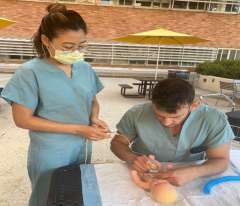
The simulation program consists of an annual 2-day boot camp that occurs at the beginning of each academic year and is repeated 3 more times throughout the year as a mini 1-day boot camp refresher. The boot camp encompasses all of the following topics and procedures.
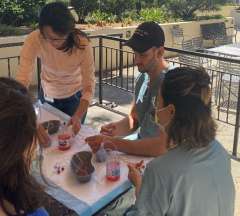
- NRP recertification for NICU fellows
- Procedural Skills Station
- Pericardiocentesis
- Paracentesis
- Exchange transfusion
- Intraosseous insertion
- Thoracentesis
- Chest tube insertion
- Pigtail catheter insertion
- Lumbar puncture
- Umbilical venous and arterial catheterization
- Synchronized cardioversion
- Defibrillation
- Crisis management scenarios/mock codes
- Arrhythmia identification and management (supraventricular tachycardia, ventricular tachycardia, ventricular fibrillation, atrial flutter, complete heart block, torsade de pointes)
- Advanced NRP resuscitation in the delivery room and NICU
- Cardiac tamponade requiring pericardiocentesis
- Hydropic infant requiring thoracentesis and paracentesis in the delivery room
- Tension pneumothorax requiring chest tube or pigtail catheter insertion
- Hyperbilirubinemia requiring exchange transfusion
- Septic shock requiring intraosseous insertion and sepsis management
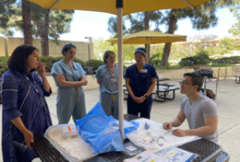
- Utilization of innovative educational techniques and NICU equipment
- 3D printer to develop neonatal thorax cavity for chest tube insertion/thoracentesis
- External pacemaker
- Glidescope
In Situ Mock Codes
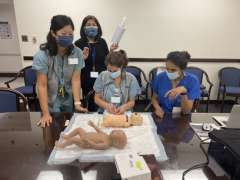
In addition to the boot camp, we implement multidisciplinary in situ mock codes in the NICU. As the team leader, NICU fellows guide nurses, residents, nurse practitioners and respiratory therapists in mock codes to maintain NRP, procedural and team skills.
NICU Faculty Simulation
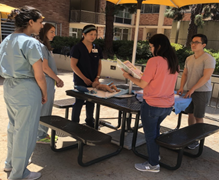
Simulation for NICU faculty members is held once every 2 years at the UCLA Simulation Center for skill maintenance. Advanced procedures are demonstrated and practiced on low and high fidelity mannequins. Advanced procedures include the following:
- Pericardiocentesis
- Paracentesis
- Exchange transfusion
- Intraosseous insertion
- Thoracentesis
- Chest tube insertion
- Pigtail catheter insertion
- Lumbar puncture
- Umbilical venous and arterial catheterization
- Synchronized cardioversion
- Defibrillation
ECMO Simulation
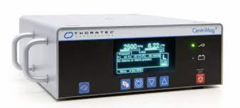
In collaboration with the ECMO Perfusionist Department, we have implemented ECMO Simulation. The purpose of ECMO Simulation is to develop technical, cognitive and behavioral skills for ECMO NICU crisis management situations. During ECMO simulation, we review the different ECMO circuits and participate in simulation scenarios which include NICU ECMO management and ECMO emergencies. ECMO simulation occurs annually for NICU fellows.
Point of Care Ultrasound
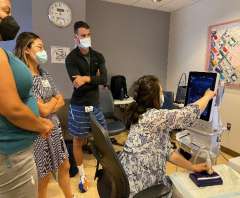
We introduced point of care ultrasound (POCUS) in the neonatal-perinatal fellowship program in early 2021. Physicians perform POCUS at the bedside, and it has become a procedural and diagnostic tool. It enables physicians to augment clinical examinations and procedures. Currently, we have multiple POCUS simulation workshop trainings and bedside clinical sessions throughout the year. We utilize POCUS for guided procedures, such as PIV, arterial line, lumbar punctures, pericardiocentesis, thoracentesis, and paracentesis. We also use POCUS to evaluate the heart, lungs, brain and abdomen.
UCLA Simulation Center
We have a strong collaboration with UCLA Simulation Center without which the Neonatal Perinatal Simulation Program would not have been established. The wonderful team at UCLA Simulation Center have supported our simulation education needs and much more.
NICU Simulation Faculty members
- Margaret Nguyen, MD
- Josephine Enciso, MD
- Meena Garg, MD
- Theodore De Beritto, MD
Keywords: UCLA Simulation Center, Margaret Nguyen, Josephine Enciso, Meena Garg, Theodore De Beritto, boot camp, in situ mock codes, point of care ultrasound, simulation curriculum