
About Us
October 2026 –
Quality and Laboratory Stewardship
Advancing Quality and Stewardship Across Pathology and Laboratory Medicine
As we look back on fiscal year 2026, it’s exciting to reflect on the productivity of our Quality Improvement and Laboratory Stewardship programs. Both initiatives have been instrumental in driving enhancements in patient care, operational efficiency, and building upon our culture of continuous improvement across the department.
Quality Improvement Updates
As we continue to seek opportunities to drive improvements for our patients and UCLA Health through interdepartmental collaborations, our Quality Improvement (QI) Program stands at the forefront of driving impactful, sustainable change. Over the past year, we have not only expanded our QI efforts, but also fostered critical interdisciplinary collaborations that transcend departmental silos and enhance our ability to deliver superior patient care and operational excellence.
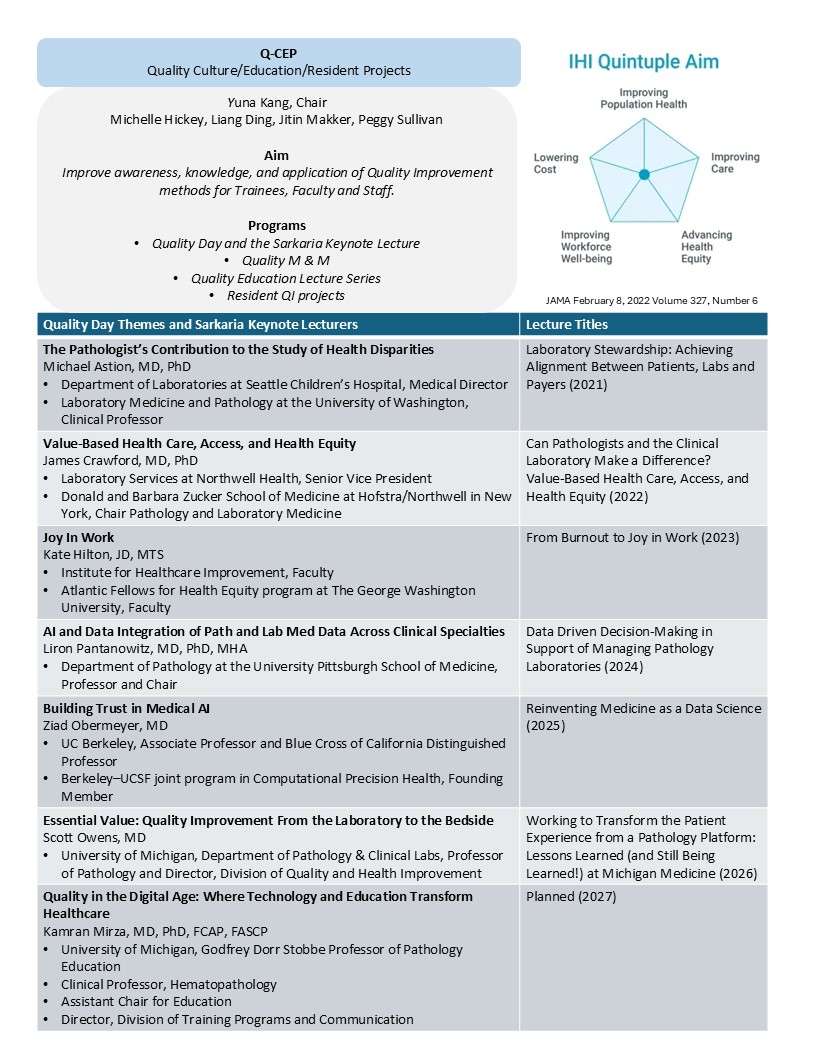
At the heart of this progress are our faculty, staff, and trainees, who provide essential leadership and support for the program’s infrastructure and lead QI projects to improve patient care and operations. The department’s QI initiatives are guided by three committees, each with distinct goals and strategic plans. One of these, the Q-CEP Committee, chaired by Dr. Yuna Kang, focuses on cultivating a Quality Culture through Education and ensures that residents actively participate in QI Projects aligned with ACGME milestone requirements.
To support the educational mission, Q-CEP hosts multiple educational events. The Quality M&M Conference, held twice a year, provides a non-punitive forum for discussing adverse or near-miss events, emphasizing root cause analysis and corrective actions. The Quality Improvement Projects Sessions invite Trainees with ongoing or completed quality projects to discuss their outcomes. The annual Quality Improvement Day, featuring the Daljit S. and Elaine Sarkaria Keynote Lecture, has evolved significantly over the past five years, now including thematic workshops alongside the keynote lecture; this also showcases resident-led QI projects.
The themes of Quality Improvement Day are aligned with the Quintuple Aim framework developed by the Institute for Healthcare Improvement (IHI), which encourages health systems to improve population health, enhance care experiences, reduce costs, support clinician well-being, and advance high-quality health care for all patients.
Meet the Program Leaders – Quality Improvement
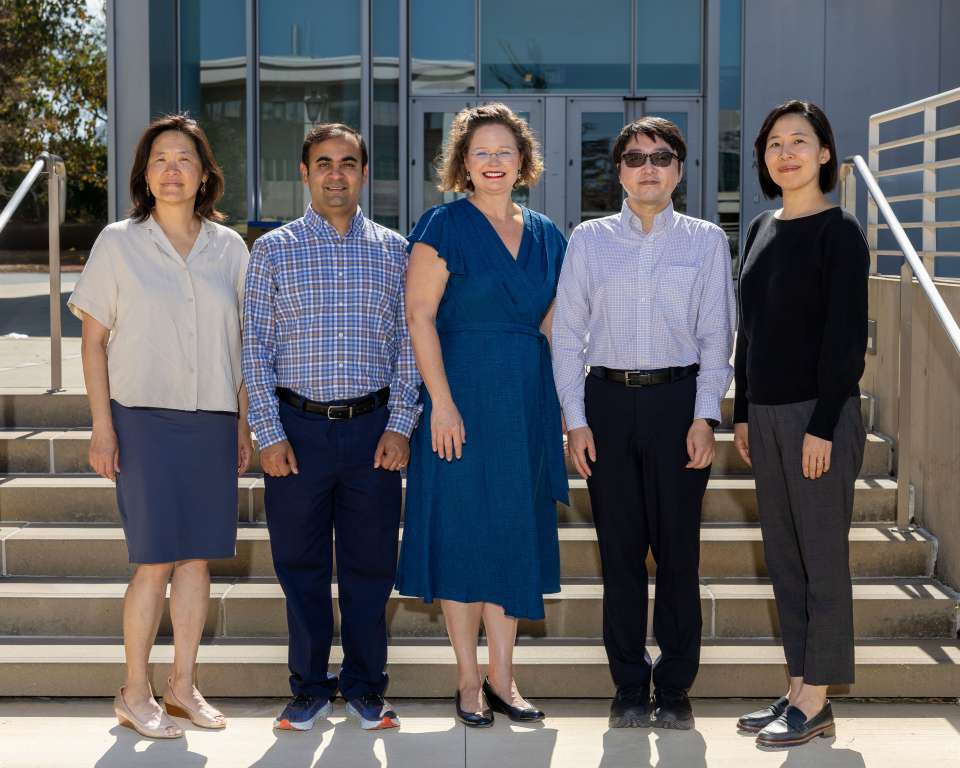
- Dr. Michelle Hickey – Director, Quality Improvement Program
- Dr. Yuna Kang – Chair of the Q-CEP Quality Culture/Education/Resident Projects Committee
- Dr. Peggy Sullivan – Q-CEP Committee Member
- Dr. Jitin Makker – Q-CEP Committee Member
- Dr. Liang Ding – Q-CEP Committee Member
Daljit S. and Elaine Sarkaria Keynote Lecture
Looking ahead to 2027, we are honored to welcome Dr. Kamran Mirza, University of Michigan, as our keynote speaker. Dr. Mirza, an internationally recognized pathologist and leader in modernizing medical education, will present on “Quality in the Digital Age: Where Technology and Education Transform Healthcare”. His work exemplifies the integration of clinical excellence with systemic and educational improvement, aligning perfectly with our department’s QI missions.
Together, these initiatives underscore our commitment to embedding quality into every facet of pathology and laboratory medicine – from education to clinical practice and innovation.
Completed Quality Projects
On behalf of the Quality Improvement Program, we would like to extend our sincere congratulations to the teams who have completed their Quality Improvement projects.
Their successful projects reflect their dedication to improving healthcare and their commitment to making a positive difference in patient care. Through their efforts, they have identified opportunities for improvement and implemented meaningful changes that contribute to better outcomes for our patients.
Quality Improvement plays an important role in strengthening the care we provide. Their work highlights how collaboration, innovation, and a commitment to continuous improvement can lead to meaningful and lasting changes in healthcare delivery.
We are pleased to recognize and celebrate their accomplishments and the positive impact their work has made.
Factor V Leiden and Factor II c.*97G>A Variants
Project Lead: Dr. Josh Deignan
The goal of this initiative was to reduce inappropriate Factor V Leiden and Factor II c.*97G>A (F2/F5) genetic test ordering in the inpatient setting. These tests are typically ordered in the setting of stroke or unexplained blood clots; however, the majority of inpatients were being discharged before F2/F5 results were available, and even if the results were available during the admission, providers were generally not acting on them. Therefore, they developed a new CareConnect tool to restrict inpatient F2/F5 genetic test ordering to the Hematology-Oncology and Neurology services, and they enabled providers in other areas to consult with Hematology-Oncology as needed. The implementation of this workflow has already resulted in an ~40% decrease in inpatient orders for these genetic tests, with additional targeted education planned for the near future.
Pathology for Surgeons
Project Lead: Dr. Kene Ojukwu
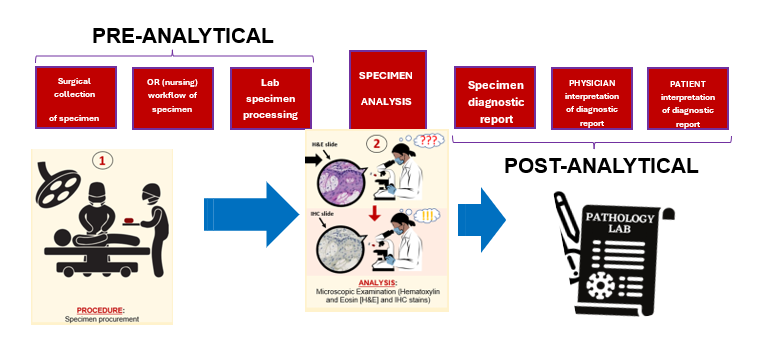
Pathology for Surgeons became a QLC project around the same time that a patient safety team review identified 54 specimen-handling events over five months, including mislabeled, unlabeled, and improperly transported specimens. These events highlighted a recurring risk to diagnostic quality and patient safety and reinforced the need to help surgical teams better understand the specimen journey.
The project has since grown through collaboration with colleagues at UCLA, Cedars-Sinai, and the University of Washington. Our simulation-based curriculum focuses on specimen submission, margin assessment, pathology-report interpretation, and intraoperative consultation. Knowledge improved across our multidisciplinary trainee groups, with the largest pre- to post-test gains among the surgical trainees. What has meant the most, however, has been hearing trainees express appreciation for understanding how specimens move through pathology and how better communication can support safer patient care.
Referral Lab Optimizations
Project Leads: William Werre, Alex Martin, Marivic Visico, Dr. Josh Deignan, Dr. Alyssa Ziman, and Dr. Allison Chambliss
The Referral Lab Optimization project has successfully transitioned from a quality improvement project to an ongoing laboratory stewardship initiative, establishing sustainable infrastructure for compliance, oversight, and reference lab utilization across UCLA Health. Initial workflow enhancements restricted “miscellaneous” send-out orders to approved reference laboratories, ensuring that we complied with CLIA and CDPH requirements. From there, high-volume and high-impact “miscellaneous” send-out tests were reviewed by subject matter experts across Pathology & Laboratory Medicine and transitioned into discrete CareConnect builds with structured data fields and defined workflows. In May 2026, they reached their project goal of completing 150 new test builds.
Resident Quality Improvement Project Presentations
Our Resident Quality Improvement Project Presentations will take place on Tuesday, November 10, 2026. This event provides an opportunity to showcase the hard work and innovation of our residents as they share the results of their Quality Improvement projects.
Three trainees will present their projects to faculty and fellow residents, highlighting the quality improvement initiatives they have developed and implemented throughout their residency training. Presentations will focus on the goals of each project, the approaches used to address identified areas for improvement, outcomes and lessons learned, and the potential impact on patient care and clinical practice.
These presentations are an important part of our residency program’s commitment to continuous quality improvement, scholarly activity, and professional development. They also provide a valuable forum for residents to share ideas, celebrate their accomplishments, and engage colleagues in meaningful discussion about opportunities to improve the quality and delivery of care.
We look forward to recognizing our trainees and showcasing the thoughtful work they have undertaken to make a positive impact within our clinical learning environment.
- Dr. Giovanni Botten – Development of a 12-color Flow Cytometry Panel to Detect Monotypic T-cells
- Dr. Chao Chen – Evaluating the Potential for Cytologists to Independently Sign Out Negative Urine Cytology Cases Based on the Paris System: A Retrospective Study in a Single Medical Center
- Dr. Donald Doanman – IHC QC Reference Guide QI project
Laboratory Stewardship Updates
The UCLA Health Laboratory Stewardship Program continues to advance our commitment to delivering high-value, patient-centered diagnostic care by promoting that patients receive the right laboratory tests at the right time. During FY26, the program expanded its reach across the health system through new collaborations, technology-enabled solutions, and data-driven stewardship initiatives designed to improve clinical decision-making, operational efficiency, and responsible utilization of laboratory services.
The program continued to expand its specialty-focused stewardship efforts with the formation of a Laboratory Stewardship Artificial Intelligence (AI) subcommittee, chaired by Dr. Khalda Ibrahim, and a Laboratory Stewardship Genetics subcommittee, which will be chaired by Dr. Josh Deignan. These groups bring together subject matter experts from both the labs and the clinics to identify and advance stewardship opportunities within increasingly complex areas of laboratory testing.
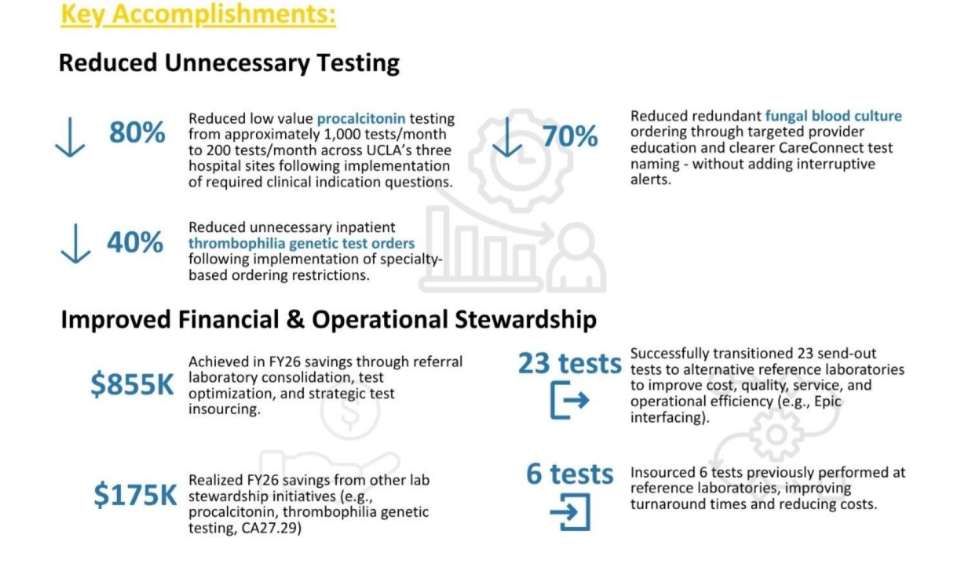
Measurable Impacts on Test Utilization
Several initiatives this year demonstrate how targeted changes to test ordering workflows can have a meaningful impact.
The Laboratory Stewardship Infectious Disease subcommittee was established to address opportunities for improving the appropriate use of microbiology and other infectious disease testing. One of the subcommittee’s early priorities was procalcitonin, where concerns about high utilization and cost and lack of clinical value led to the implementation of required clinical indication questions on the procalcitonin order in CareConnect. Since implementation, procalcitonin test volumes have sustainably decreased from approximately 1000 tests per month to approximately 200 tests per month across UCLA’s three hospital sites, while maintaining access when clinically appropriate.
The Infectious Disease subcommittee also addressed unnecessary fungal blood culture ordering. Fungal blood cultures were being ordered in relatively high volumes despite limited appropriate indications; candida and cryptococcus species are typically detected by routine bacterial blood cultures and don’t require a separate fungal culture order. A chart review confirmed that the fungal culture rarely identified organisms that wouldn’t otherwise be found on the routine blood culture. Following targeted education and clearer naming to distinguish the two blood culture orders in CareConnect, fungal blood culture ordering decreased by approximately 70%. This initiative demonstrates how a relatively simple change in terminology can effectively point providers to the right test without adding interruptive alerts.
Continued Reference Lab Optimization
Following up on the completion of the QLC Reference Lab Optimization project, Laboratory Stewardship initiated a reference laboratory “crosswalk” initiative to identify opportunities for referral laboratory consolidation, test optimization, strategic test in-sourcing, and cost savings across our referral lab test menu. Guided by a multidisciplinary team of operational, clinical, and faculty leaders, the review carefully balanced efficiency goals with our continued commitment to high-quality testing and patient care.
In the first year of the initiative, 23 send-out tests were pivoted to different reference labs, and 6 tests that were previously performed at reference labs were brought in-house. Through this collaborative stewardship effort, the department realized $855,000 in reference lab cost savings during the 2025-2026 fiscal year. These efforts also delivered meaningful operational benefits, including streamlined workflows, reduced manual specimen and result handling, improved turnaround times, increased interfaced result reporting, and greater standardization across testing platforms. Building on this success, Laboratory Stewardship will continue this work in the coming fiscal year, pursuing additional opportunities to enhance reference lab quality, service, operational efficiency, and fiscal stewardship.
Strengthening Oncology Test Stewardship
As new and emerging diagnostic tests become increasingly available, the Laboratory Stewardship Task Force (LSTF) has strengthened its partnership with Oncology to ensure that new oncology reference labs and tests are appropriately evaluated before being implemented for UCLA patients. Working with Oncology and with support of the Laboratory Stewardship Oversight Committee (LSOC), comprised of key health system leaders, LSTF established standardized approval criteria for new oncology send-out test requests:
- The performing laboratory has active CLIA (federal) and CDPH (state) lab certifications, AND
- The requested test meets at least one of the following:
- Positive Medicare coverage determination (e.g., NCD or LCD), AND/OR
- Incorporated into a widely accepted applicable guideline (e.g., NCCN), AND/OR
- Required for a clinical trial occurring at UCLA
This approach provides greater consistency and transparency while maintaining an exception process for urgent or clinically necessary patient care, as necessary.
Laboratory Stewardship has also continued their efforts to reduce redundant ordering of the clinically equivalent breast cancer tumor markers CA 15-3 and CA 27.29. Following multiple stewardship interventions and collaborations with Cancer Services and Oncology leadership, the CA 27.29 send-out test will be removed from CareConnect effective October 1, 2026, with CA 15-3 remaining available as the preferred test performed within the UCLA laboratories.
Improving Genetic Testing Workflows and Utilization
Technological advances and increased laboratory integrations within Epic continue to create new opportunities for Laboratory Stewardship. Following the integration of Natera (which provides genetic testing for Women’s Health/OBGYN and Oncology) into CareConnect, Invitae (which provides genetic Cardiology, Neurology, and Hereditary Cancer panels) was integrated through Epic Aura in 2026, allowing genetic testing orders and results to move directly through CareConnect rather than rely on paper orders or outside web portals. These integrations improve the provider experience while also providing greater visibility into test utilization.
Laboratory Stewardship is now using the utilization data from these newly integrated reference labs to evaluate ordering patterns and identify opportunities for provider education, increased electronic ordering, reference laboratory consolidation, test standardization, and additional genetic testing stewardship.
Collaboration and National Leadership
Laboratory Stewardship continues to grow through collaboration across UCLA Health. Partnerships with Oncology, Infectious Diseases, Genetics, Informatics, and other clinical areas have been instrumental in developing interventions that balance appropriate utilization with the needs of clinicians and patients.
The program’s expertise is also contributing to laboratory stewardship nationally. Dr. Josh Deignan was elected to the Epic Genetics & Genomics Steering Board, providing UCLA and the Department of Pathology and Laboratory Medicine with representation in discussions surrounding the future of genetics and genomics functionality within Epic. Additionally, Drs. Allison Chambliss and Josh Deignan were appointed to the American Society for Clinical Pathology’s (ASCP) Effective Test Utilization Steering Committee, where they will contribute to the development of national recommendations for effective laboratory test utilization.
Looking Ahead
The Laboratory Stewardship program will continue to build on this progress by monitoring the sustainability of current interventions and focus on strengthening its data and metrics driven approach to better measure the clinical, operational, and financial impact of stewardship initiatives. The program will also continue to expand collaboration across UCLA Health and explore opportunities to parter with other University of California health systems to share best practices, identify common stewardship priorities, and pursue collaborative initiatives.
Through these efforts, the program aims to broaden its impact, demonstrate the value of laboratory stewardship, and support sustainable improvements in laboratory utilization and patient care.
For more information, including recent news such as conference presentations and articles, we welcome you to visit our Laboratory Stewardship Program webpage.
Meet the Program Leaders – Laboratory Stewardship
- Dr. Allison Chambliss – Director of Laboratory Stewardship; Laboratory Stewardship Task Force Co-Chair; Clinical Chemistry
- Dr. Josh Deignan – Laboratory Stewardship Task Force Co-Chair; Molecular Diagnostics
- Dr. Omai Garner – Vice Chair for Clinical Laboratory Affairs; Clinical Microbiology
- Alex Martin, PA (ASCP), MHA – Laboratory Stewardship Task Force Co-Chair; Director of Operations, Anatomic Pathology
- Maria Estrada, MHA, PMP – Program Manager, Laboratory Stewardship and Inclusive Excellence
Sarah M. Dry, MD
Chair, Department of Pathology & Laboratory Medicine