
2026-2027 UCLA Neurology Chief Resident Q&A
Meet the 2026-2027 UCLA Neurology Chief Residents!
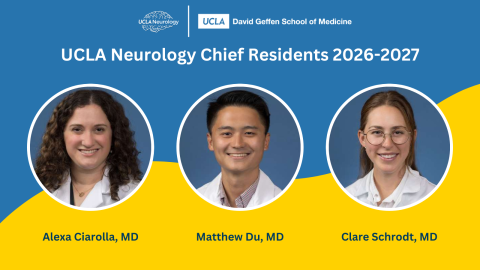
Congratulations to Drs. Alexa Ciarolla, Matthew Du, and Clare Schrodt for their appointments as the 2026-2027 UCLA Neurology Chief Residents! We are looking forward to seeing their leadership, care, and excellence in action. Read below to learn about their motivations to pursue neurology, aspirations for this upcoming year, and more!
What inspired you to go into Neurology?
Alexa Ciarolla: It was a combination of factors; mainly that neurology seemed to be the most exciting and intellectually stimulating to me, but that it also contained important human moments. Oftentimes neurologic diseases can be life altering and sometimes disabling, and so much of what we do can determine quality of life for patients and their family. I think learning about what makes our patients people and implementing that into treatment decisions makes the field far more rewarding than just the physiologic diseases we treat.
Matthew Du: The patients! I loved the type of relationship formed with patients due to the loss of function in neurological disease. I also love localizing neuroanatomy as well.
Clare Schrodt: I was attracted very early in my medical training to the gravity of neurological disease. The stakes tend to be high in Neurology, and because of that, I have found patients have a deep investment in their own healing that keeps me motivated to learn and innovate in the field. It’s this kind of two-way vulnerability that challenges me emotionally and scientifically. Also, who doesn’t love to localize??
What are your goals for the next year as a Chief Resident?
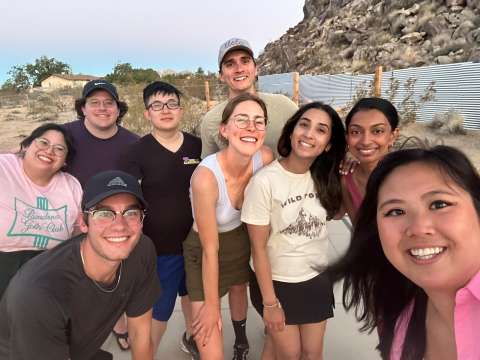
Alexa Ciarolla: I really want to optimize the experience our residents have - we have the privilege of being in a position that can advocate for our peers and ourselves. I feel as chiefs there's a duty to improve what we can and in doing so find a way to navigate the desires of our residents with the needs of the program and the institution as whole.
Matthew Du: I aim to improve on some of the med ed initiatives in the program. I'm hoping to continue to improve on the relevance on our didactics for clinical learning (maybe bringing in more stroke didactics learning to match up with the amount of stroke we see on the wards), improve the way we do morning report, and also increase exposure and proficiency in neurophysiology and neuromuscular disease.
Clare Schrodt: My biggest goal this year is to improve the lives of our residents. I think this program produces fantastic neurologists, but to make sure we are truly successful when we graduate, mental and spiritual health of our residents needs to be a top priority. I feel strongly that stellar academic training does not need to come at the cost of residents’ sleep, relationships, and hobbies outside of medicine.
What excites you most about the UCLA Neurology residency program?
Alexa Ciarolla: The opportunities! It truly is what we make it. If there's an idea, our faculty have been so supportive in making it happen. They represent a variety of fields and if there's an interest, they will take extra time to teach and support our residents' interests.
Matthew Du: We have amazing leadership that allows residents to take charge of improving the program. The residents all have various passions and share a joy of learning neurology.
Clare Schrodt: Even as a July/August intern, I learned quickly that when a problem arises within our residency, this program seeks to find solutions. Our faculty care deeply about our growth as rising neurologists, and there is an expectation of continued forward progression as a program. Also, I think the way our program is structured, we get such excellent exposure to pathology across the spectrum of Neurology. As I get closer to being an independent practitioner, I value this exposure more and more.
What are your career goals? How do you think this residency program will help you achieve those goals?
Alexa Ciarolla: I am currently applying for fellowship in neurocritical care, and I hope to continue with a career in academics following training. I have had great mentors in our neuro ICU faculty and fantastic support from all of our neuro ICU staff that have helped to foster and grow my interest in the field.
Matthew Du: I aspire to excel as a clinician while being significantly involved in the medical education activities of fellows, residents, and medical students.
Clare Schrodt: I plan to complete fellowship training in MS and Neuroimmunology, and my ultimate goal is to have an interdisciplinary clinic for this patient population that offers personalized diet and lifestyle interventions as adjuvants to their traditional disease modifying therapies. On the academic front, I have always loved working within medical school admissions and medical student training, so I hope to remain within the academic sector once I graduate!
What piece of advice would you give to someone at the start of residency?
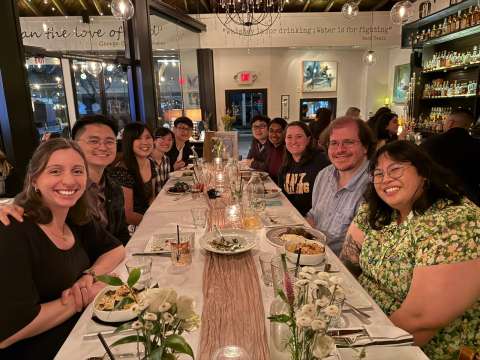
Alexa Ciarolla: It does eventually get better - after many hours on pager and seeing dozens of patients, consults start to feel more like second nature and the learning becomes natural. Depend on your coresidents, family, friends to help get you to that point and find the things that keep you happy.
Matthew Du: Residency is the best time to learn, ask questions, gather/share opinions, and seek out wisdom from others (e.g. faculty, patients, co-residents). It is a marathon not a sprint so try to commit to staying engaged in at least one activity that is is important to you throughout (e.g. sport, hobbies, religious activity, family). It is also a very doable time to transition life stages (e.g. getting married, having kids etc.)
Clare Schrodt: Knowing your priorities, and ensuring your life is structured to honor those, will be paramount. The hardest part of residency for me was figuring out how to structure my free time meaningfully; I learned that doing this made my time both in and out of work exceedingly more valuable. One other piece of advice a senior once gave me was to “protect the vibe at all costs.” Though this seems simple, it truly is everything. Whether you want to be on your fourth week of the stroke service at RR or not, your attitude about the day will completely dictate how you perceive what is happening around you. Residency is emotionally and physically taxing, but I have found that small mindset shifts, and being as present as I possibly can be at work, has major impacts on my stress levels and the resilience of my team.
If you were a part of the brain, what part would you be and why?
Alexa Ciarolla: Probably the cerebellum, because most of my favorite hobbies involve some sort of movement (hiking, running, sailing, skiing) and the cerebellum contributes to motor coordination, balance, and motor learning!
Matthew Du: The thalamus, I have joy in networking and connecting people to each other!
Clare Schrodt: The cerebellum. When I’m not at work, I’m running on the beach, cooking, skiing, trying a new restaurant, or reading on the roof. If you need coordination, I’m your girl. Also, as an aside, can we give the cerebellum some credit? She’s doing a whole lot and I feel like we are giving the cerebrum all the attention. Representation for the posterior fossa.
We’re excited to have these three amazing leaders guiding the next year of UCLA Neurology residency!