
Integrative Biostatistics and Bioinformatics Core
Combining state-of-the-art statistics with bioinformatic knowledge bases, we will provide services to support researchers and clinicians interested in integrating clinical and biological data (e.g. microbiota, metabolites, metagenomics, transcriptomics, epigenetics, multimodal neuroimaging data obtained from human and animal studies).
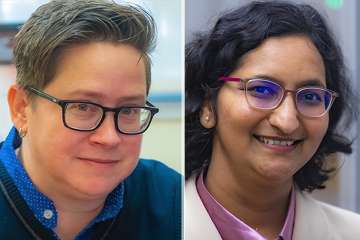
Integrative Biostatistics and Bioinformatics Core Director: Jennifer S. Labus, PhD
Integrative Biostatistics and Bioinformatics Core Co-Director: Swapna Joshi, PhD
Senior Biostatistician: Iris Wang, MSc
For any questions or core service requests, please complete this form.
Services of the Integrative Biostatistics and Bioinformatics Core
Microbiome sequence and biostatistical analysis
Delivering state-of-the-art biostatistical and bioinformatic expertise for hypothesis- and data-driven studies (cross-sectional and longitudinal).
- Methods and capabilities: Diversity analyses, functional profiling, and differential abundance modeling using general linear and Bayesian frameworks.
- Machine learning: Unsupervised and supervised learning algorithms tailored to complex microbiome datasets.
Multi-omics integration and systems biology
Translating complex multi-layered biological data into meaningful pathobiological insights.
- Pathway and network analysis: Graph theory-based association networks, co-inertia analysis, sparse generalized canonical correlation, graphical models, and Bayesian networks.
- Machine learning: Supervised models (sparse partial least squares, elastic net regression, boosting) and unsupervised ensemble clustering.
- Deep learning applications: Deep neural networks (DNNs), convolutional neural networks (CNNs), and autoencoders.
Grant writing, experimental design, and study planning
Partnering with investigators early in the research lifecycle to maximize study rigor and funding potential.
- Study design: Developing robust hypotheses, experimental designs, and statistical power/analytic plans for new proposals and ongoing studies.
- Data mining: Leveraging existing datasets to generate preliminary data for new grant applications.
Scientific writing, manuscript support, and data visualization
Transforming complex multi-omics output into publication- and funding-ready deliverables.
- Grant and manuscript integration: Drafting rigorous methodology sections and analytic plans for grant proposals, study protocols, and research manuscripts.
- High-impact visualization: Designing publication-ready figures, interactive data views, and intuitive visual summaries to communicate key findings clearly.
Translational and clinical interpretation
Bridging the gap between raw data and biological relevance in both human and animal model studies.
- Mechanistic insights: Contextualizing multi-omics results to elucidate pathobiological mechanisms and biomarker discovery.
- Collaborative support: Working closely with primary investigators to turn complex statistical outputs into actionable scientific conclusions.