Inspiring the Next Generation: UCLA Anesthesiology Launches Ninth Year of Outreach and Pipeline Program
Inspiring the Next Generation: UCLA Anesthesiology Launches Ninth Year of Outreach and Pipeline Program
Written by Sophia P. Poorsattar, MD
Now in its ninth year, the UCLA Department of Anesthesiology and Perioperative Medicine continues its longstanding commitment to community engagement through our UCLA Project Lead the Way (PLTW) outreach and biomedical pipeline program. This partnership with Venice High School, El Segundo High School, and the California Society of Anesthesiologists aims to inspire students of all backgrounds to explore careers in medicine and anesthesiology. The program has been widely recognized for its educational impact, with students consistently reporting that these hands-on sessions strengthen their interest in STEMM fields and deepen their understanding of anesthesiology.
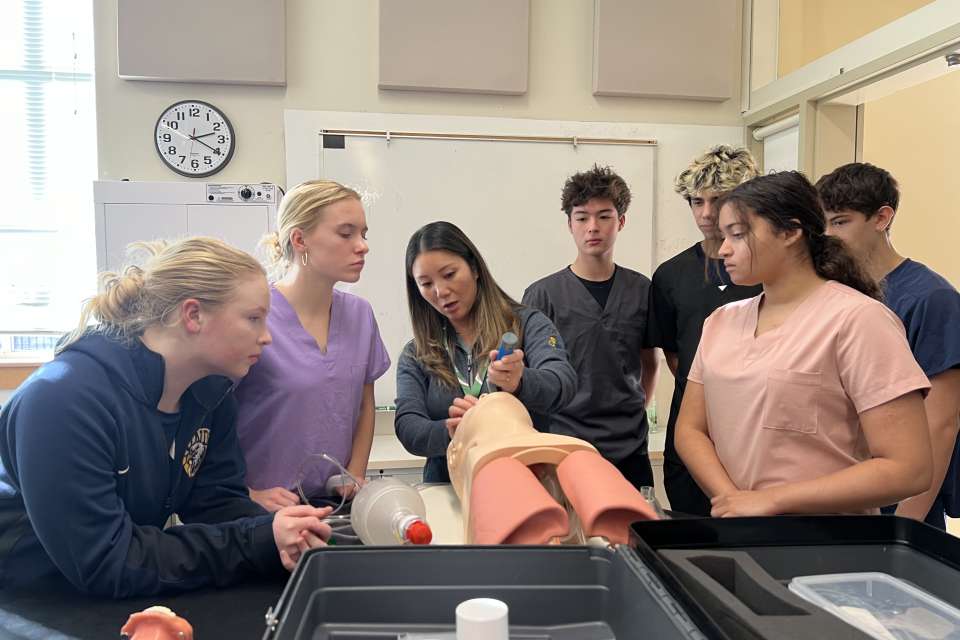
Led by program director Sophia P. Poorsattar, MD, volunteers completed classroom visits to Venice High School this fall. Participating faculty members included Marisa Hernandez-Morgan, MD, and Ali Salehi, MD, along with resident physicians Sruthi Jaishankar, MD, and Thibault Philippine, MD. Several volunteers also visited El Segundo High School—faculty members John Patton, MD, and Sandra Sacks, MD, fellow physician Brandon Sumida, MD, and resident physician Salvatore Daddario, MD. Each visit opened with an interactive discussion on pathways to medicine and the role of anesthesiologists, followed by four in-depth breakout sessions on various topics in airway management and cardiopulmonary resuscitation designed to connect the students’ biomedical coursework to real-world clinical decision-making.
In the mask ventilation and airway adjuncts station, students learned how to perform a basic airway exam, identify features of difficult ventilation, distinguish apnea from obstruction, and practice using oral and nasal airways to maintain patency. The direct and video laryngoscopy station introduced airway anatomy, positioning, and visualization techniques, allowing students to compare laryngoscope blades and understand why clinicians choose one approach over another—particularly in trauma cases or challenging airway scenarios. At the adult CPR station, volunteers guided students through assessing unresponsiveness, initiating compressions, recognizing effective CPR, and discussing the implications of delayed or inadequate resuscitation. Finally, the pediatric CPR station highlighted the developmental differences in airway management, breathing assessment, and compression techniques for infants and children, emphasizing how these adaptations improve survival.
These fall visits represent the first of our three annual touchpoints with each school. In the winter, our teams will return to the schools for hands-on sessions in point-of-care ultrasound (POCUS), allowing students to explore cardiac, vascular, and pulmonary anatomy using real-time imaging. The program culminates each spring with a field trip to UCLA’s operating rooms, where students rotate through immersive stations in airway management, regional anesthesia, intraoperative monitoring, and advanced simulation.
Our residents, fellows, and faculty remain at the heart of this outreach effort, and their dedication continues to shape the next generation of biomedical leaders.