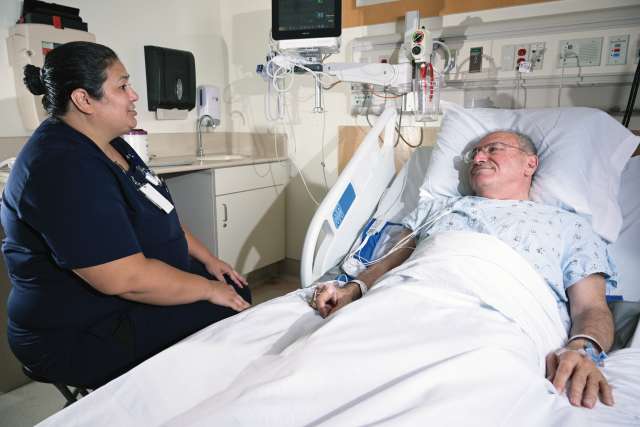
Relationship-based care (RBC) is a three-pronged model of care that emphasizes the relationship between nurses and patients, nurses and their colleagues and nurses with themselves. It often is described as the linchpin of nursing at UCLA Health. It’s introduced during orientation, embedded in the professional practice model and supported through shared governance and self-care retreats such as Reigniting the Spirit of Caring.
CICARE (Connect, Introduce, Communicate, Ask, Respond, Exit) is an approach to delivering care that emphasizes personalized interactions with patients to build relationships. CICARE training is mandatory for all new hires at UCLA Health and is reinforced through ongoing education and development programs and Nursing’s professional governance system.
Both RBC and CICARE are longstanding programs designed to provide compassionate, collaborative and individualized patient-centered care that emphasizes forming connections with patients, families and each other.
“In nursing, our professional practice model is grounded in caring science, relationship-based care and role accountability — all centered on one core truth: relationships are at the heart of everything we do,”
says Jessica Phillips, PhD, MSN, RN, NEA-BC, NPD-BC, executive director of Nursing Practice, Education and Research at the Center for Nursing Excellence.
Dr. Phillips notes that nurses often consider care as their relationship with the patient alone. “But we don’t have the strength of our care delivery without the other two relationships: our colleagues and ourselves.”
Putting Theory Into Practice
For Tessia Martinez, RN, practicing the principles of RBC and CICARE means treating patients with respect and ensuring they feel seen and heard.
“For me, these initiatives are the foundation of building that patient–nurse connection and trust,” says Martinez, who works on the Cardiac & Thoracic Surgery Unit (7 West) at Ronald Reagan UCLA Medical Center. “You have to build a relationship in order to have that connection, that trust with the patient, by addressing both their medical and emotional needs.”
Martinez implements these concepts into her daily practice by introducing herself at the change of shifts, explaining the care plan to the patient, asking about their expectations, and addressing pain management and other issues the patient is experiencing. She focuses on making her patients feel comfortable, despite being away from their home and routine, she says.
Megan Wesseln, MSN-Ed, RN, CCRN, CNL, nursing professional development practitioner at the Center for Nursing Excellence, emphasizes that nurses can better engage their patients in their plan of care by creating strong and meaningful connections with every person, every time.
“When we practice these principles, we work in synergy with nursing and interdisciplinary colleagues to deliver comprehensive care and achieve the best possible outcomes for our patients,” she explains.
‘Time With U’
A program aimed at enhancing patient engagement was reintroduced this past year. “Time With U” is a systemwide initiative, rolled out in partnership with the Office of Patient Experience, that provides foldable stools in patient rooms to encourage eye-level patient interactions.
The stools have encouraged interdisciplinary use, inviting nurses, physicians and other caregivers to pause and give their full attention to engaging with their patient.
“I think that’s really at the heart of what patient-centered care is,” says Kelly Anderson, MSN-Ed, RN, NPD-BC, nursing professional development specialist. “Giving us the time and the tools to encourage that behavior shows patients that they are our whole focus.”
Research shows patients feel more “heard” when providers are at eye level, Anderson notes, and patients feel more inclined to share when they’re in an engaged, one-on-one conversation.
“The action of being eye-to-eye on the same level and giving someone your full attention can be really powerful,” says Anderson, who is also the Relationship-Based Care program lead at the Center for Nursing Excellence. “It can just be for five minutes. And that can be incredibly meaningful.”
Wesseln states that the program has shown positive effects on patient experience, with several units reporting higher satisfaction scores. At UCLA Santa Monica Medical Center, patient satisfaction scores dropped below the benchmark to 79.6% in the fourth quarter of fiscal year 2024, based on Press Ganey results for postprocedural discharge instructions. An evidence-based improvement plan was implemented to increase patient satisfaction with discharge instructions by introducing “Time With U” stools, providing discharge folders and using the teach-back method to clarify instructions.
The hospital reported that patient satisfaction scores increased to 85.93% in the third quarter of fiscal year 2025. Wesseln also highlights RRUCLA’s Surgical Unit (8 West), where the stools were integrated into a three-year project that resulted in zero harm from falls.
Showcasing Teamwork
“Time With U” is increasing engagement among nurses and other care providers, too. For instance, nurses on UCLA Santa Monica Medical Center’s Orthopaedics Unit (3 North) held a competition to bedazzle their stools, which not only highlighted their unity and creativity but also became showpieces to spark conversations among interdisciplinary team members and patients.
The competition was part of a broader unit project focused on enhancing the nurse–patient connection that encouraged use of the stools at least once per shift. To keep the initiative top of mind, charge nurses used the bedazzled stools as prompts during huddles. As part of this effort, scores on the HCAHPS question “Nurses listen carefully to you” improved from 72.06% in fiscal year 2024 to 77.27% in the first quarter of fiscal year 2025 and 76.47% in the second quarter of 2025.
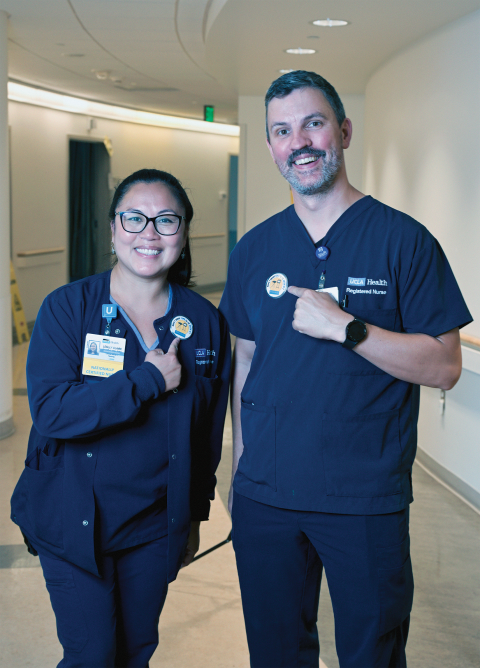
On 7 West, Martinez’s unit created promotional badges for staff to wear that spark conversations with patients and serve as reminders to nurses to use the stools. They also implemented informational fliers in patient rooms and at nursing stations that explain “Time With U” expectations.
“So it’s improving patient engagement and patient experience,” Wesseln says, “but it’s also a celebration of collaboration and teamwork. Staff see the artfully decorated stools and say, ‘This is so fun, tell us the story behind it.”
Culture of Collaboration
Anderson says when she thinks about the relationship-based care and CICARE models, it reminds her that decisions affecting what the work environment looks like, what patient care looks like and how nurses take care of themselves are driven by the nurses at the bedside, starting with the Unit Practice Councils and trickling outward and upward.
“I think about the amazing work, especially over the last couple of years, that professional governance has done, not just with projects, but also sharing it so that nurses can either apply it on their units or adapt it on their units,” she says. “It promotes a culture of collaboration and real ownership and pride in the work that we do.”