“We’re listening, and we’ve got you!” That’s the message of SupportingYou, the nurse-led, peer-to-peer support initiative that provides timely intervention after challenging events such as medical errors, patient deaths, workplace violence or other personal work-related challenges.
Developed as an arm of the systemwide safety initiative A Safer U, SupportingYou was inspired by the need to reduce turnover due to burnout and to prevent long-term mental health consequences and suicide among health care providers, says Patrick Loney, MBA, RN, NEA-BC, chief nursing officer at the Resnick Neuropsychiatric Hospital at UCLA.
“One of the things that we know is that, unfortunately, in our world today, health care workers are subject to burnout. Experiencing direct and vicarious trauma and workplace violence is a real issue in all hospitals and is also true for us,” Loney says. “If left unchecked, those things build up over time and they create a burden on the nurse.”
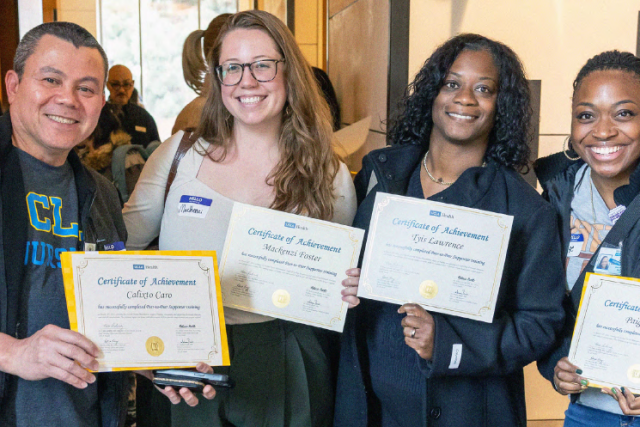
Sixty-five UCLA Health frontline nurses have been trained as peer supporters for the pilot program, which rolled out in April at the Westwood campus hospitals. Peer supporters received training on how to support a coworker through a crisis, including what peer support is and what it isn’t, Loney says.
“It also gives them resources for when people need assistance beyond a peer supporter, like staff and faculty counseling or other mental health services. And if it’s an emergency, they know how to escalate it to the appropriate level of care,” he says.
Filling a Need

Loney is part of an interdisciplinary steering committee that helped construct the SupportingYou pilot program. Members include Nursing leaders, frontline nurses, social workers, chaplains and staff from the risk management and performance excellence departments. The committee is led by Melissa Powell, PhD, MS, RN, CPHQ, a postdoctoral fellow in the UCLA National Clinician Scholars Program.
“A Safer U at UCLA Health is focused on widespread safety initiatives, but we also recognize that part of a safe environment includes caring for our clinicians,” Dr. Powell says. “And so, the peer-to-peer support pilot program is really focused on emotional first aid and empowering nurses with access to a broad range of referral resources.”
Peer-to-peer support was often mentioned as a need during rounding and meetings with stakeholders and frontline nurses, Loney says. “Nurses wanted it, nurses are part of creating it, and now nurses are part of delivering it. So, it’s very responsive to a need.”
An expert in peer support, Dr. Powell examined existing literature and research to identify what evidence-based practices exist for peer-to-peer support programs, which are gaining in popularity throughout the health care industry.
“That helped us build our program, design our infrastructure and form a steering committee to make decisions, start creating materials and plan for training,” she says.
An international expert in peer support, Dr. Susan Scott, MD, of MU Healthcare/University of Missouri, led the training, a four-hour intensive session with didactic learning simulation and Q&A “that really got these peer supporters ready for when we launched the program,” Powell says.
Seeking Leaders and Listeners
Part of the committee’s work was to decide what qualities were important in a peer supporter; they identified empathy, leadership skills and a strong desire to provide emotional aid. Applicants completed a survey about themselves and why they wanted to be a peer supporter. They also required their manager’s endorsement to confirm they would be a good fit.
“My motivation to become a peer supporter comes from a desire to help others feel less alone,” says Heather Radder, BSN, RN, NC-BC, a clinical nurse II on the Nursing System Float Team. “Nursing can be rewarding, but also emotionally and mentally challenging at times. I know how much it helps to talk to someone who understands what I am going through, and I want to be that kind of support for others.”
Nurses can seek support from peer supporters within their own unit — colleagues who understand their specific work environment — or connect with someone from another area if they prefer. All conversations are confidential, creating a safe space for nurses to share and receive support.
Requests for support can be made through an online survey, using the QR code on the Nursing website. In addition, if a manager believes a staff member could benefit from peer support, they can nominate that person by completing the form.
Making a Positive Impact
Dr. Powell says the response to the program has been overwhelmingly positive. In fact, she said, during the two weeks between training and the rollout, nurses were already providing support on their units.
“We talked about requests coming in through Qualtrics, but these nurses, they provide support to patients all day, every day. They do it naturally,” Dr. Powell says.
“They’re built empathetically to do this work. So, a lot of that local support speaks to the ingrained culture that we want to see on these units.”
The committee hopes to expand the program systemwide. The next steps will be gathering effectiveness data through interviews with supporters and supportees.
“We also will look at institutional metrics to see if there were changes in turnover or changes in the Culture of Safety survey data connected to A Safer U,” Dr. Powell says.
“We’ve already gotten some feedback from peer supporters saying, ‘Hey, I want a three-slide deck to present at my local staff meeting. Can you guys create that?’ And we created it,” she adds. “So, I think the feedback throughout is really going to help us meet the needs and adapt to make the program successful.”
"Nurses wanted it, nurses are part of creating it, and now nurses are part of delivering it."
Patrick Loney
Chief Nursing Officer, Resnick Neuropsychiatric Hospital at UCLA