Nursing excellence can be measured in myriad ways, whether it’s a heartfelt thank you from a grateful patient, the nomination of an exceptional nurse for a Daisy Award, or the feeling of satisfaction a unit experiences when a project it has implemented leads to better outcomes.
One of the more visible ways a health care system measures nursing excellence is by achieving Magnet® designation from the American Nurses Credentialing Center (ANCC) Magnet® Recognition Program®.
Magnet® is considered the gold standard for nursing excellence; as of 2025, fewer than 10% of health care organizations out of nearly 6,100 nationwide are recognized with Magnet® designation.
As of 2024, UCLA Health’s Magnet®-eligible hospitals have earned a combined nine Magnet® designations over the course of their Magnet® journeys — a milestone that underscores a long-standing culture of nursing excellence across the system. Chief Nursing Executive Karen Grimley, PhD, MBA, RN, NEA-BC, FACHE, FAAN, describes it as “a powerful confirmation of our deep and sustained commitment to nursing excellence. It reflects how strongly this organization supports professional nursing practice — not just in words, but in action.”
Setting the Standard
The most recent Magnet® recognition was conferred this spring, as Ronald Reagan UCLA Medical Center achieved its fifth consecutive designation, placing it in an elite group: Only about 17% of Magnet®-designated organizations have achieved a fifth designation or higher, representing less than 2% of all U.S. hospitals.
In 2024, Resnick Neuropsychiatric Hospital at UCLA earned its second Magnet® designation, which is extremely rare for a psychiatric facility; in 2019, Resnick was the second in the nation to achieve Magnet® status and is just one of two with a second designation.
UCLA Santa Monica Medical Center has two consecutive designations and completed its on-site visit in July for a third designation, expected to be conferred this fall.
Earning 5 Magnet® designations is an exceptional achievement that continues to be celebrated systemwide. And although the designation is conferred every four years, the work never stops, says Kateri Tobias, MSN, RN, former nursing practice outcomes and Magnet® program coordinator.
“Magnet® organizations are pushing the boundaries, advancing nursing care,” Tobias says. “Others look to us to set the standard — and that responsibility isn’t tied to a four-year cycle. It’s something we live out every day through a continuous drive to raise the bar.”
Magnet® Explained
The Magnet Recognition Program® is an evidence-based pathway created by the ANCC to set a benchmark for nursing excellence. The program originated from a 1980s study by the American Academy of Nursing, which examined hospitals that attracted and kept highly skilled nurses who provided exemplary, compassionate and patient-centered care. The mission of the Magnet® program is “to elevate patient care around the world in an environment where nurses, in collaboration with the interprofessional team, flourish by setting the standard for excellence through leadership, scientific discovery and dissemination and implementation of new knowledge.”
The original Magnet® model comprised 14 Forces of Magnetism. To understand how the program was named, visualize the forces of a magnet attracting nurses at every level, in every role. In 2008, the 14 forces were grouped into five key components: Transformational Leadership, Structural Empowerment, Exemplary Professional Practice, New Knowledge, Innovations & Improvements, and Empirical Outcomes.
UCLA Health Nursing has intentionally aligned those five components with its Professional Governance Councils, which form the foundational structure of Magnet® culture, says Jessica Phillips, PhD, MSN, RN, NEA-BC, NPD-BC, executive director of nursing practice, education and research and the Magnet® program director for the Center for Nursing Excellence at UCLA Health.
“Magnet® culture promotes the voice of the nurse being strong in the organization, and it signifies the strength in interprofessional relationships within the organization,” Dr. Phillips says. “It moves beyond just nursing to how we deliver care collectively as an organization. It also helps organizations create healthy work environments where nurses can thrive and be leaders.”
Setting a High Bar
Magnet® redesignation timeline
Year 1 (Designation year): Continue to document the work Nursing is doing.
Year 2 (Interim year): Submit interim monitoring reports and data on RN satisfaction, nurse-sensitive indicators and patient satisfaction.
Year 3 (Application year): Submit the application by the last day of the anniversary month. Additional documentation is required, including organizational charts and database lists.
Year 4 (Documentation submission): Submit supplemental documents and written documentation by the first business day of the month closest to the organization’s designation month. The organization is then notified of a date for the site visit. Notification of designation is made about three months following the site visit.
Source: American Nurses Credentialing Center
To earn Magnet® recognition, health care systems must surpass the national standards in three areas: patient experience, RN satisfaction and nurse-sensitive indicators.
For organizations seeking Magnet® redesignation, the bar is even higher: Rather than maintaining the status quo, organizations must continually outperform themselves, as well as the national mean, to retain their Magnet® designation. This means providing interim reports that demonstrate they continue to meet or exceed Magnet® standards, with a majority of units outperforming national benchmarks for eight consecutive quarters.
In one example from RRUCLA’s latest Magnet® recognition, metrics from nurse-sensitive indicators across eligible inpatient units revealed that Nursing consistently outperformed national benchmarks from Q2 2022 through Q1 2024:
- Falls With Injury: 20 of 23 units outperformed for most of the eight quarters
- HAPI Stage 2: 17 of 19 units outperformed
- CLABSI: 12 of 19 units outperformed
- Device-Related HAPI: 17 of 19 units outperformed
In another example from the same time period, RRUCLA tracked three nurse-sensitive indicators across eligible ambulatory care settings, with the majority consistently outperforming national benchmarks:
- Patient Burns: 5 of 5 units overperformed
- Falls With Injury:4 of 5 units outperformed
- Surgical Errors: 5 of 5 units outperformed
Performance in both examples was benchmarked against the Press Ganey NDNOI Academic Medical Centers cohort mean.
Tobias, who retired in June 2025 after a 36-year nursing career at UCLA Health, was particularly proud of the patient satisfaction metrics in the ambulatory care settings, which improved significantly from 2020, when they did not meet national benchmarks, she said.
“It’s something that I worked on closely with the unit directors for the ambulatory areas, collaborated with the Patient Experience Office, and helped them align their work so that they could outperform by Magnet® standards,” she says.
The Site Visit
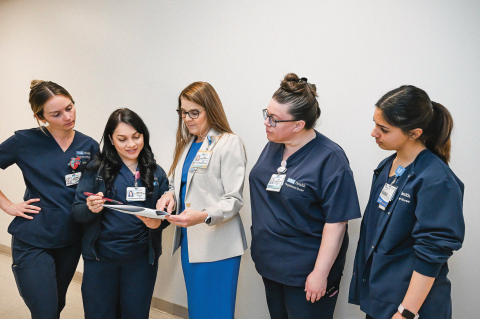
One of the most anticipated events of the four-year Magnet® cycle is the three-day on-site visit, in which a team of appraisers examines the achievements of Nursing through interviews with nurses throughout the organization, highlighting their projects and accomplishments over the four years.
Tobias says, for her, it’s the most inspiring part of the Magnet® journey.
“The site visit gives everybody a renewed sense of energy when they realize what they’ve accomplished and gives them the ability to look back and see how far they’ve come,” she says. “I find that incredibly inspiring because it gives us fuel for the future.”
Nikki Taylor, RN, is the Unit Practice Council chair for the PICU and PCTU units at RRUCLA and served as a Magnet® Fellow during year four of the facility’s most recent Magnet® cycle. Her role included conducting mock site visits that focused on anticipated questions from the appraisers and preparing the units for the visit.
The site visit can be stressful for nurses, she says, but “I just told them to be natural and let your unique abilities and units shine instead of feeling like it’s a test with questions you’re going to get wrong. I let them know what the appraisers were going to look for, that they really focused on nurse certification rates and projects with actual facts instead of unfinished ones.”
During the year, she visited almost every unit to see their projects, providing feedback, answering questions and brainstorming projects she would like to do in her unit. During the on-site visit, she accompanied the appraisers for all three days, facilitated unit coordination and timing, and participated in the debrief after the visit.
“The most joyful part of it for me was getting to share what Magnet® is with my coworkers and helping them see that they are already doing the work,” she says. “And I don’t think they know how proud of themselves they should be of all the hard work they actually do.”
Recognizing Exemplary Work
During the recent site visit at RRUCLA, appraisers engaged with more than 570 nurses and other team members across the organization and learned about several highly valued programs supporting clinical nurse practice.
In its report, the team highlighted multiple areas of outstanding practice, including an initiative titled “Reducing Falls on 8 North – Liver Transplant Unit.” The unit cares for patients at high risk for falls due to complex health conditions. Nurses collaborated with clinical experts to implement a comprehensive fall prevention bundle that included patient-specific risk assessments, enhanced hourly rounding, new visual cues at the bedside and increased staff education through simulations and skills refreshers.
Before/After Snapshot:
- Before: January 2023 – 3.62 falls per 1,000 patient days
- After: May–July 2023 – average of 0.83 falls per 1,000 patient days, with zero falls in June and July
The initiative improved patient safety and helped nurses proactively manage fall risks. Staff engagement increased through education, visual tracking of progress and recognition for achieving fall-reduction milestones.
The appraisers also recognized an initiative from the Cardiothoracic Surgical ICU titled “Fast-Track ExtubationProtocol,” which emphasized nurse autonomy, early readiness assessments, clear bedside criteria and interdisciplinary collaboration with physicians, respiratory therapists and physical therapists. The protocol resulted in faster extubation, earlier patient mobility, reduced ICU length of stay and fewer ventilator-associated complications.
Before/After Snapshot:
- Before (Q4 2021): Post-surgical CABG/valve patient Average Length of Stay (Observed/Expected Index) = 1.23 days.
- After (2023): Reduced to an average of 0.90 days, a 26.8% reduction, while exceeding national benchmarks for early extubation in 10 out of 12 months.
In addition, the appraisers praised the work of EBP projects presented at a UPC Summit, including:
- “Share a LEAF”: A multimodal fall prevention initiative using enhanced visual cues and patient/family education, leading to a reduction in falls. Introduced on 6 West (Medical-Surgical Specialty Unit)
- Safe Patient Handling Initiative: A unit-driven injury prevention effort promoting safe patient movement practices for staff safety. Launched on 7 West (Cardiac & Thoracic Surgery Unit)
Fostering a Culture of Excellence
Studies have shown that Magnet®-designated hospitals have better patient outcomes, lower mortality and infection rates, and increased patient safety and patient satisfaction rates, Dr. Phillips says. Magnet® recognition also helps hospitals attract highly qualified nurses, which results in higher retention, higher nursing engagement scores and increased opportunities for professional development.
Magnet® vs. non-Magnet® hospitals
- 18% of nurses were less likely to be dissatisfied with their job
- 13% of nurses were less likely to report high levels of burnout
- 14% lower mortality rate
- 12% lower odds of failure to rescue
- 5% lower average fall rate
*(Sources cited at the end of the story)
“What these redesignations say about the future of the nursing profession is that we are fostering a culture of excellence, improving patient care and supporting the development of a stronger and healthier workforce,” Dr. Phillips says.
“Magnet® is part of our reputation, it’s part of our brand, it’s part of who we are,” she continues. “It’s part of the pride in recruiting and retaining top talent. And it’s an expectation that nurses have of themselves, of the nursing workforce at UCLA Health. And my role is ensuring that we have all the pieces in place to grow and nurture that culture and environment so that we’re not just sustaining, but we’re continuing to take steps forward.”
*Sources for Magnet® vs. non-Magnet® stats