
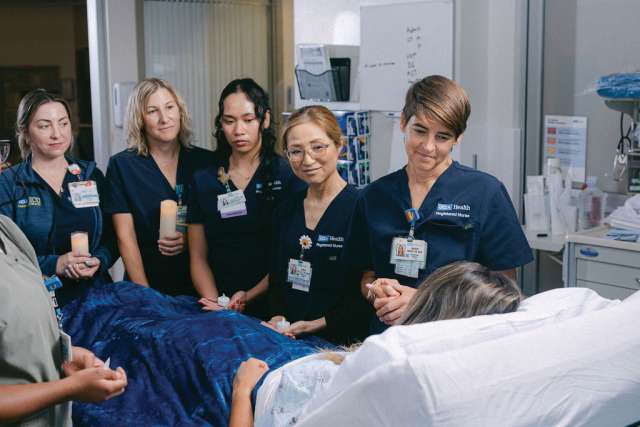
Lindsay Brant’s ‘Community’ program is gaining nationwide attention.
In a society that places a premium on prolonging life, Lindsay Brant, BSN, RN, CCRN, EOLD, MFA, is on a mission to illuminate how the end of life can be meaningful, too, if we let it.
In 2023, Brant launched a nurse- led initiative centered on providing compassionate palliative care in her unit. Called “Community,” the group of nurses met monthly to discuss approaches they could implement. Since then, Community has expanded to encompass several initiatives designed to help nurses feel more comfortable not only caring for patients in the dying process but also communicating with the patient and family about that process.
“I always hope the family will feel comfortable sharing about their loved one, so we can communicate with patients, even when they’re nonresponsive, about what is true and meaningful to them.” says Brant, a critical care nurse in the cardiothoracic ICU at UCLA Health.
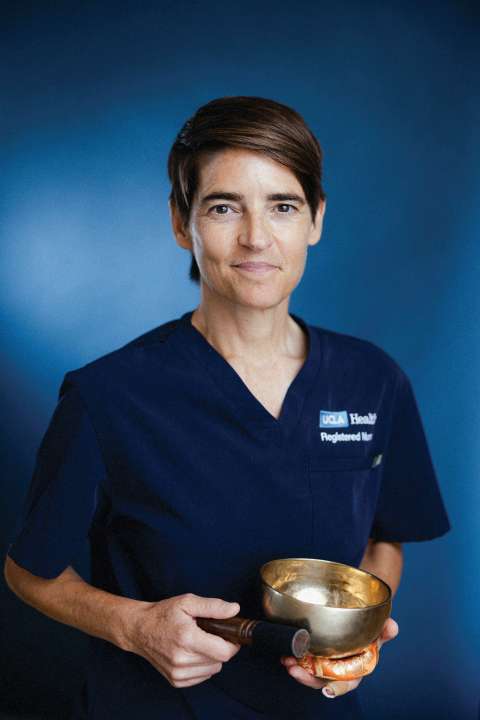
Community Impact
Throughout her career, Brant has advocated for healing patients through nontraditional means. In 2015, she was selected as one of the first clinicians at UCLA Health to participate in the Urban Zen Integrative Therapy program, brought to UCLA by fashion designer Donna Karan through her Urban Zen Foundation.
She traces her passion for palliative care to the book “Being with Dying,” by Roshi Joan Halifax — required reading for the Urban Zen program.
Today, the Community committee she started with just 12 nurses on her unit has morphed into a program with nationwide impact. Brant notes that every initiative the committee puts forward is either backed by evidence-based practice or they are actively engaging in developing science around it.
Initiatives include:
Moment of Silence: The entire caregiving team assembles after a patient passes to silently honor the patient and family, and the care that was provided. Also known as the medical Pause, the practice was inspired by educator Jonathan Bartels, RN, and has been adopted at health care systems throughout the nation.
“It is an extraordinary ritual,” says Brant. “We honor the patient and thank the family for letting us care for them, and the family has an opportunity to share their gratitude with our team. This shared, reciprocal gratitude is very profound. It begins a process of closure for all of us.”
Goals of Care: Nurses are provided questions that can prompt intimate conversations with the patient and family about their wishes for end-of-life care. These are put in the patient’s notes and are shared with the medical team during rounds.
3 Wishes: Clinical staff work with the patient and family to look for favorite memories and special qualities that honor the patient and celebrate their unique life in the most meaningful way possible. This has included delivering personalized photos, family keepsakes or favorite music to the patient and family at the bedside or celebrating special occasions.
Brant recounts how her team helped organize a wedding, decorating the room and using the long hall of the ICU as the church aisle.
“We had a harpist there, and the bride wore a wedding dress with her dad carrying the train. It was a beautiful collaboration between 3 Wishes and our team.”
Threshold Choir: This nationwide organization brings musicians to the ICU to sing to patients every Thursday. “The Threshold Choir transports patients outside of their hospital room experience because their voices are so soothing and harmonic,” says Brant, who adds that “every now and then you’ll see a doctor with their ear to the door, because we need it, and we love it, too.”
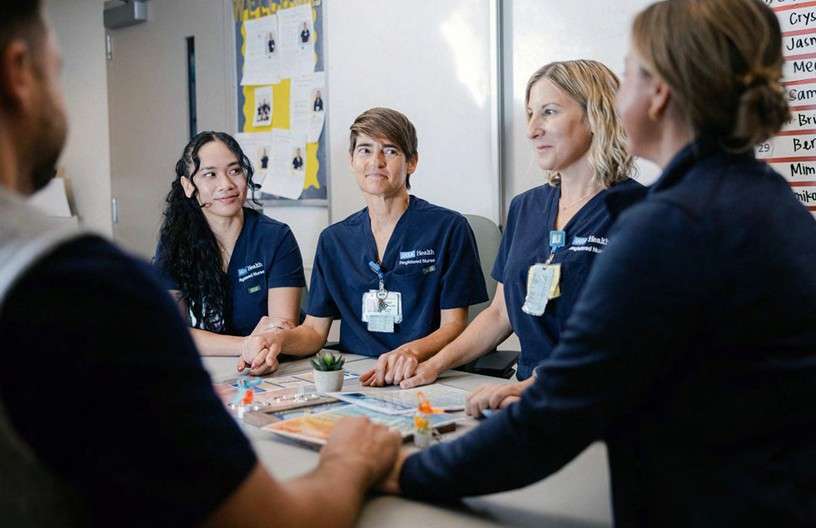
Show Up and Share: An open forum outside of the workplace allows clinicians to share how they are feeling, emotionally and psychologically. Through sharing their experiences, Brant says, “we can grieve and support each other. And I think that just totally changed the game. We have a place where we can be incredibly vulnerable with each other, and it’s OK. It’s encouraged.”
Community is gaining traction nationally.
In May, their work was presented at the American Association of Critical Care Nurses’ 2025 National Teaching Institute and Critical Care Exposition in New Orleans. Brant also presented at the Nursing Ethics Conference and at End Well 2024, a national end-of-life conference held at the Skirball Cultural Center.
Patient Advocate
Foremost among Brant’s goals is that patients maintain their dignity and autonomy throughout the end-of-life process.
“We should never lose sight of how to respect our patients — never allow our medical approach to lose sight of the person,” she says.
Occasionally, that means she must advocate for her patients against medical recommendations. Brant recalls a young patient who had endured procedure after procedure and decided she didn’t want to continue.
“That gave me the opportunity to really listen to her and be an advocate for what she wanted,” Brant says. “I, of course, appreciate the importance of a positivist approach … but there’s a point when we can’t ignore where a patient truly is. The goals of care of a patient can change, and we need to be there in that moment, receptive to that change, and prepared to switch gears in order to respect their wishes.”

Breaking Down Barriers
Brant says she’s gratified to see the difference Community is making — not only with patients and families, but with her team in the ICU, which tends to be an intense environment in which nurses put up emotional barriers to protect themselves from their experiences.
She points to a colleague who expressed to her how radically the Community initiatives have affected the way he thinks about nursing; that the teamwork and closeness and shared emotions allow him to cry at work if he needs to, instead of shoving it down and moving on.
For Brant, moments like that are profound.
“Often the impulse is to shut down,” she says. “But if we’re working together as a family, taking care of each other at the same time we are taking care of our patents, we become more engaged, more loving, and our work becomes more meaningful.”