
Over the past few years, artificial intelligence (AI) has transformed the way we learn, work and play. UCLA Health Nursing is at the forefront of this revolution, aiding in the development and refinement of AI tools that streamline workflows, reduce cognitive and administrative burdens, enhance documentation and improve patient-centered care.
In 2022, a focus group emerged from Nursing’s New Knowledge and Innovation Council (NKI) to evaluate AI tools specifically designed for nursing workflows. The group comprises about 20 nurses from various specialties across UCLA Health, including ambulatory, inpatient, lactation, blood bank and NICU. It also includes clinical nurse specialists, educators and unit directors.
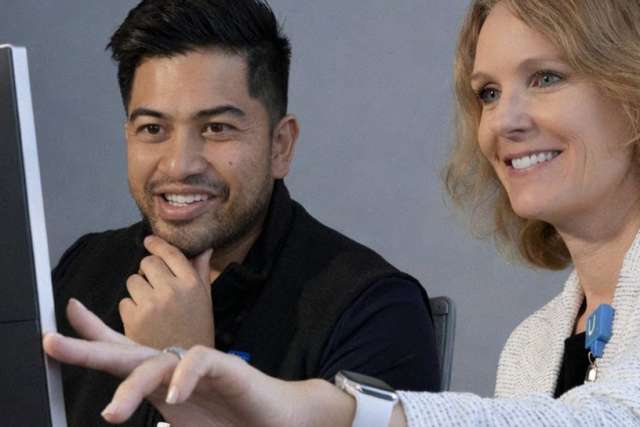
Led by Nursing Informatics, focus group sessions include education on AI tools, hands-on validation and design input from nurses. The emphasis is on transparency, safety and alignment with University of California’s AI principles, says Donna Wellbaum, MSN, RN, NEA-BC, NI-BC, chief nursing informatics officer at UCLA Health, the executive sponsor of the group.
Validating New Tools

AI tools go through many iterations and approvals before they are adopted, Wellbaum says, including submitting them to the UCLA Health AI Council (HAIC), which evaluates new models for bias and ensures patient privacy safeguards are in place.
Education on the tools is also presented to the NKI and Evidence-Based Practice councils, as well as to various nursing groups.
“We’re very intentional about involving staff in the development of any of our tools. It’s our guiding principle,” Wellbaum explains. “We won’t put an AI tool out there that hasn’t been validated by our nursing staff. To ensure broad input, we bring these tools to many of our professional governance committees to gather their perspectives and ideas on enhancing adoption and awareness.”
Putting AI Into Practice
AI tools that have already been approved and put into practice include:
- A Care Coordination tool that identifies high-risk patients who should be prioritized for additional outreach
- A generative AI tool that drafts responses to patients’ medical advice queries
In addition, the AI Focus Group is collaborating with the Office of Health Information and Analytics and UCLA Health’s technology vendors to develop and evaluate these tools:
- Insight Summaries: Quickly sifts through the patient’s chart to generate a summary of recent events based on parameters set by the nurse
- End of Shift Report: Summarizes charting updates, care plans and goals for the next shift
- Nursing Knowledge-Base: A search tool integrating information from the diverse digital reference libraries available for nurses at UCLA Health; provides nurses faster access to reference materials to support evidence-based practices
- Care Transition Handoff: Summarizes the patient’s condition, treatments and ongoing needs, from ED to inpatient and ICU stepdown
Saving Time, Reducing Burnout

AI Focus Group member Michael Malig, BSN, RN, CGRN, a clinical nurse II at the UCLA Health primary care clinic in Santa Clarita, says he’s excited about the time the AI tools will “give back” to nurses, who often are caring for multiple patients simultaneously.
“We wear so many hats,” says Malig.
Quote: “And I think these tools will give us information that’s clear and succinct and decrease cognitive burden so we can focus on patient care.”
Janar Bauirjan, MSN, RN-BC, CNRN, a resource nurse on the medical-surgical nursing system float team and a focus group member, believes AI tools can play a critical role in reducing clinician burnout. “Wherever we can find ways to save time safely and effectively, it goes a long way toward retaining the nurses who remain at the bedside,” she says.
She appreciates the hands-on nature of the focus group, which simulates real patient scenarios routinely encountered on the floor. The key, she says, is involving nurses every step of the way.
“Those who have worked with nurses know that if we’re given technology that isn’t relevant or practical, it simply won’t be adopted,” says Bauirjan. “That’s why it’s so important for us to be engaged from the start — shaping these tools into something truly usable.”
Next Steps
The Insight Summaries tool is being tested as a pilot for a small, select group of nurses to use and provide feedback to EPIC, the developer, Wellbaum says.
Additional opportunities for AI tools include ambient voice recognition to create notes or discrete documentation in clinical flowsheets. Also in the works are AI tools that can predict risks for falls, suicide and workplace violence.
Wellbaum emphasizes that AI is being used to augment nurses’ work and decrease their administrative burden. “It’s never here to take away that human element or the critical thinking that’s so vital to being a nurse,” she says.