For decades, hip replacement surgeries were performed through the rear, which requires severing muscle tissue and tendons to access the damaged joint.
But in the late 1990s, the strategy changed. Surgeons realized they could preserve those muscles and tendons by approaching the hip joint from the front, which also led to quicker patient recovery.
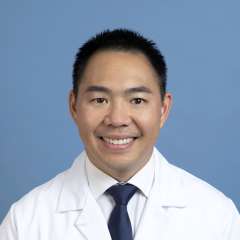
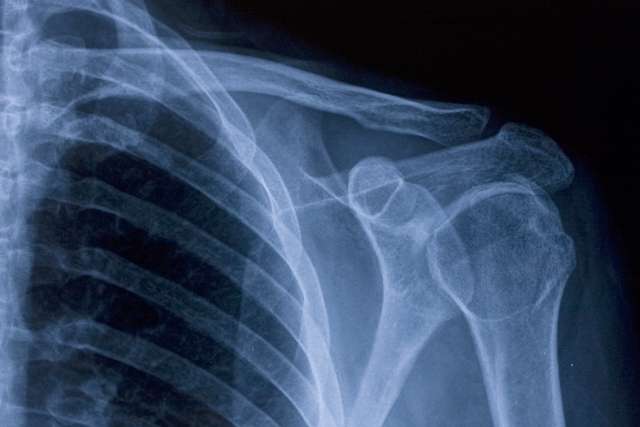
Now, UCLA Health orthopedic surgeon Ed Cheung, MD, is advancing a similar paradigm shift in shoulder replacement surgery. Dr. Cheung is among a small cohort of surgeons in the U.S. and Europe pioneering shoulder replacement procedures from the back rather than the front. The new approach spares the rotator cuff, a group of muscles and tendons surrounding the shoulder joint that allow the movement and rotation of the upper arm and shoulder.
A new approach to shoulder replacement
In traditional shoulder replacement surgery, surgeons approach from the front, cutting rotator cuff tendons to access the shoulder joint, then repairing them during the procedure.
“You’re relying on biology and surgical technique to heal that tendon,” Dr. Cheung says.
Approaching the joint from the back, however, leaves these tendons unharmed, so patients can recover more quickly.
“The holy grail of shoulder replacement is to be able to do it and then not have people wear a sling afterwards, because you haven't violated any of the tendons in the shoulder,” Dr. Cheung says.
With traditional shoulder replacement, patients typically wear a sling for three to six weeks before beginning active physical therapy to restore range of motion. With the new approach, they only need a sling for two or three days, he says.
UCLA Health is one of just a few places in the country to offer this procedure. Michael Greiwe, MD, a Kentucky orthopedic surgeon who developed the approach in 2017, is leading a cohort of fellow surgeons who hope to make posterior shoulder replacement surgery more widely available.
The group has met several times to practice the procedure in cadaver labs and discuss how to make it “doable, reproducible, and then hopefully teachable to various surgeons around the country,” Dr. Cheung says.
Who needs shoulder replacement surgery?
Also known as shoulder arthroplasty, shoulder replacement surgery is common, with an estimated 174,000 performed in 2025, according to a study in the Journal of Shoulder and Elbow Surgery.
Joint replacements – shoulder, hip or knee – are used to treat arthritis and the accompanying loss of cartilage. Cartilage is the smooth covering on bones and joints “that allow your joint to move like ice on ice,” Dr. Cheung says. When that cartilage wears away – whether through use, trauma or genetics – joint movement becomes painful and limited.
Most shoulder-replacement recipients are older than 50.
Pioneering a new procedure
While Dr. Cheung says he’s done “hundreds” of traditional shoulder replacement surgeries from the front, he’s done just 10 from the back.
He says it’s exciting and challenging to perform the procedure in a new way, comparing it to driving a familiar route in reverse. Approaching shoulder replacement from the back should theoretically be easier than the traditional way, he says, as the shoulder naturally points a few degrees toward the back.
“Imagine driving to work looking at your backup camera,” he says. “Even though it’s the same anatomy, even though it’s the same street, even though you know how to drive a car, it is very disorienting.”
The procedures have all been successful, he says, adding that patients appreciate being able to move their shoulder after just a few days, once the nerve block used during surgery wears off.
“Everybody so far has either done it because they love the fact that you don't have to be in a sling – they love the fact that I’m not violating any tendons that need to be repaired afterward,” he says. “And they love the fact that UCLA and I are on this innovative approach and they want to be part of it.”
Not everyone is a candidate for the novel approach. Someone with severe cartilage loss and deformity in the joint wouldn’t qualify.
“As I do more of these, I’m learning how to pick my patients” who will fare best, he says.
Dr. Cheung has also been videotaping the surgeries and watching them afterward, “almost like the talking heads do on Monday after football games.”
“It’s teaching me a lot,” he says.
And while there’s some inherent risk in trying a less-proven procedure, Dr. Cheung values the opportunity to inspire residents and further the field.
While there have been incredible advances in many surgeries – such as appendix and gallbladder, which are now done laparoscopically – there have been fewer in shoulder replacement. The implants have improved, but the procedure is essentially the same as it was when it was introduced in the 1950s.
“I think it’s good for the residents to see me try something new,” he says. “We have a unique opportunity at UCLA as a teaching institution. People come to UCLA because they want the latest and greatest and cutting-edge innovation. So I’m taking the leap.”