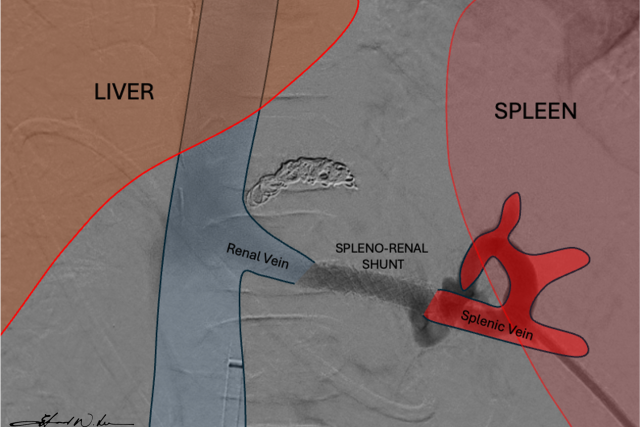
A UCLA Health interventional radiologist has performed a first-ever percutaneous spleno-renal shunt procedure in a pediatric patient to relieve severe portal hypertension.
Edward Wolfgang Lee, MD, PhD, performed the procedure in December 2025 on a 6-year-old boy with life-threatening bleeding varices (abnormally dilated veins). The child is doing well, and Dr. Lee said he hopes the minimally invasive procedure will become widely available as an alternative to an open abdominal surgery.
“I think this procedure should be promoted and needs to be taught globally as countless children would benefit,” said Dr. Lee, professor of radiology and liver transplant surgery at the David Geffen School of Medicine at UCLA. “I think the long-term outcome is very promising.”
History of bleeding
The boy had undergone a liver transplant at UCLA Health in 2021 when he was 15 months due to biliary atresia, a blockage in the bile ducts.
His surgeon, Douglas G. Farmer, MD, chief of the division of liver and pancreas transplantation, said the boy received a technical variant graft, or partial liver transplant, because there aren’t enough pediatric whole livers. Not only are children’s blood vessels much smaller, but young patients with biliary atresia commonly have a congenitally small portal vein.
“Because we’re using pieces of the liver as opposed to a whole liver, and because of the size of the patient, many times we have to deal with a higher risk of vascular complications,” said Dr. Farmer, who is also surgical director of UCLA Health’s pediatric liver transplant program.
Dr. Lee said the boy’s portal vein became completely occluded and thrombosed, which limited blood flow and nutrition to the liver.
Additionally, with blood from his abdominal organs no longer passing through the portal vein, he developed portal hypertension. The increased pressure in his portal venous system caused the blood from his stomach, intestines, pancreas and spleen to divert in the opposite direction to other veins called varices, causing them to expand, weaken and rupture.
Dr. Lee said over the last three years, the boy experienced roughly 25 bleeding episodes that had him in and out of the hospital without definitive treatment options.
Last October, he coughed up blood clots and had to be intubated at a hospital in the Inland Empire.
“He almost died,” Dr. Lee said. “He had multiple bleeding varices.”
He was transferred to UCLA Health for higher-level care. Dr. Lee said the boy was not a candidate for the commonly performed, minimally invasive Transjugular Intrahepatic Portosystemic Shunt (TIPS) procedure for variceal bleeding.
TIPS relieves portal hypertension by connecting the portal and hepatic veins to reduce the excess pressure and stop the bleeding.
However, Dr. Lee said the boy’s portal vein had been completely obliterated by chronic blood clot formation.
“We can’t really even see it anymore,” Dr. Lee said. “He has a normal hepatic vein, but no portal vein, so TIPS was not possible.”
Dr. Lee said the only other option was creating a shunt between his splenic and renal veins by cutting open his abdomen, which would have been extremely risky. After multiple past surgeries, the boy had developed a hostile abdomen.
“There’s a lot of scarring within the abdominal cavity and there would be a lot of bleeding,” Dr. Lee said. “The blood pressure within the abdominal cavity was very elevated.”
Dr. Farmer said if he had performed the open surgery, it would have lasted up to four hours with a hospital recovery time of two to three weeks. It also might not have succeeded.
“We’d have to find suitable veins to be able to suture to and perform the shunt or divert the blood flow,” he said. “There would be a chance he could clot off the surgical shunt as high as 20%.
“Any sort of open operation would potentially be successful and doable, but it would be much more difficult than these percutaneous techniques and carry much higher risks than what Dr. Lee can offer radiographically.”
Dr. Farmer said that as a last resort the boy could have been re-listed for a second liver transplant. However, his wait time would have been very long, potentially years.
“We had reached the stage where we needed to intervene,” Dr. Farmer said.
Finding another option
In 2024 and again last year, Dr. Lee had performed percutaneous spleno-renal shunt procedures on two adults who were critically ill.
To determine if the boy might also be a candidate, Dr. Lee studied his CT, MRI and ultrasound imaging from the past several years.
The procedure involves a tiny puncture through the skin and uses catheters guided by ultrasound and fluoroscopy to create the shunt and offload the pressure.
“I happened to find the splenic and renal veins were very close to each other, a little over 2 centimeters,” Dr. Lee said. “There were no other critical structures that were crossing that path, so I felt safe that I could put the needle through from the splenic vein to the renal vein and connect those two veins.”
Still, the procedure would be difficult and risky. He told the boy’s parents that he might not be able to place the shunt, and the boy could potentially die.
“They understood there was really no other option,” he said.
A first-time pediatric procedure
In December, the boy underwent the two-hour procedure under general anesthesia.
As in the previous adult cases, Dr. Lee’s team had to create specialized tools.
“All the needles, all the catheters and tools, we had to minimize and customize to his anatomy,” he said.
First, Dr. Lee punctured the boy’s left abdominal wall through the skin, directly into the spleen, and into the splenic vein. He accessed the renal vein through the boy’s leg, where he put a small target.
He used a very small needle to get from the splenic vein to the renal vein under image guidance.
“Once I confirmed we were in the renal vein, that path was enlarged and connected with a stent graft,” he said.
He created the shunt from a metal mesh lined with polytetrafluoroethylene (PTFE).
The shunt is 5 millimeters in diameter, which Dr. Lee sized based on readings of the boy’s blood pressure in his abdominal cavity. With the shunt, the pressure dropped from 10 mmHg to the normal range of below 5.
“Now there’s through and through blood coming from the splenic vein to the renal vein when normally there isn’t any,” Dr. Lee said.
By the time he finished the high stakes procedure, he said he felt as if he’d aged 20 years.
“I’ve saved a lot of patients’ lives over the last 15 years being at UCLA, but this is definitely on the top of my list of most difficult and also most rewarding procedures,” he said.
The boy stayed in the hospital for three days.
“He’s doing great,” Dr. Lee said. “So far, he hasn’t bled at all since the procedure. Hypertension has been resolved by that shunt.”
As the boy grows, Dr. Lee said he can easily make the shunt longer or bigger through a minimally invasive groin puncture.
Dr. Lee said he had not attempted this procedure until 2024 because of the potential risks of massive bleeding.
“There’s a big, pressured internal organ and I’m putting a needle through it,” he said. “If it didn’t go into the renal vein properly, now I’ve created a hole in the splenic vein and the patient can bleed out.”
He added that significant improvements in imaging modalities have made the procedure possible.
“With the advancement of technologies, we can see the veins very clearly, and there are a lot of different tools to measure the vessels,” Dr. Lee said.
Dr. Lee said half of patients with end-stage liver disease can experience portal vein thrombosis/clots. In the past, some patients have had no treatment options.
“This type of portal vein thrombosis and hypertension are actually not uncommon in pediatric patients and adults, but now we have a very effective, minimally invasive treatment option,” he said.
Dr. Farmer said Dr. Lee’s work once again shows how UCLA Health is on the leading edge of health care.
“We are setting the new standard and that’s really what UCLA is about,” Dr. Farmer said. “We develop new techniques and seek to make procedures safer and more successful using innovation. This is a classic example.”