A UCLA Health clinical trial is testing the benefits of intense “telerehabilitation” in the home for stroke survivors.
The Phase 3 study follows a decade of earlier research that demonstrated significant improvements in arm movement and overall function after in-home therapy.
The trial is currently recruiting eligible patients at more than two dozen locations across the country, with Southern California sites throughout Los Angeles, and in Irvine and San Diego.
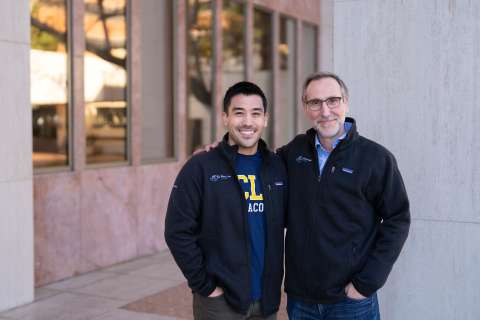
“We’re trying to rewire the brain,” says neurologist Steven Cramer, MD, director of the neurorehabilitation program at UCLA Health and principal investigator of the study.
“If I handed you a French horn and asked you to play, you’d need to work on it every day, an hour a day, for weeks, but people aren’t getting the equivalent of that when it comes to stroke rehabilitation.”
In-home therapy
The current trial is open to patients ages 18-85 who had a stroke three to nine months prior to enrollment in the study.
Telerehabilitation includes exercises and interactive, computer-based games over six weeks of therapy, six days a week. Each session is 70 minutes. A licensed therapist supervises patients via teleconference three times a week. Patients complete remaining sessions on their own.
The 35 functional games, including Whack-A-Mole and a slot machine, vary demands on the patient’s movement speed, range of motion, squeeze strength and other features of motor control.
Patients also use standard exercise equipment, such as resistance bands and light weights, to improve strength with repeated movements.
The clinical trial evaluates whether telerehabilitation targeting arm movement, when added to usual care, improves arm function and reduces global disability after stroke, compared to usual care alone (whatever therapies the patients’ medical team has already recommended for them).
Initially, only patients randomized into the telerehabilitation group will participate in the in-home sessions. Those randomized to the usual care group are also offered telerehabilitation once they complete study procedures several months later.
Even patients with post-stroke aphasia — language impairments — can participate. The games and exercises incorporate images and videos.
Movement gains
Patients who have had a stroke typically spend less than a week in the hospital. Some then go to inpatient rehabilitation facilities or nursing care facilities. About half go straight home, where they don’t have access to daily, therapist-led exercises designed to build new motor skills.
In an earlier study, Dr. Cramer compared a high-intensity home-based program with the best available in-clinic rehab programs and “both groups did spectacularly well” in terms of arm movement gains, he says.
Simply being able to move your arms isn’t good enough, though, if you want to return to work or perform household tasks such as cooking or dressing yourself.
“People appreciate getting arm movement back, but at the end of the day, what really matters is, are they more functional? Is the disability reduced?” says Dr. Cramer, also a professor of neurology at the David Geffen School of Medicine at UCLA.
He and his colleagues recorded each patient’s level of disability using a standardized scale that tests how independently people can do the tasks needed to get through the day, such as eating or getting dressed.
They found that 40% of people who completed six weeks of the daily, in-home telerehabilitation improved measurably on the disability scale.
One person who benefited is Kathy Ohtomo. The LA resident had a stroke at age 50 in 2021, resulting in left arm paralysis. After two weeks at an inpatient rehabilitation center, she began telerehabilitation immediately at home.
“It helped me a lot and it was so convenient to do it at home,” Ohtomo says. “The games were fun and they kept me motivated and diligent because I was seeing improvement.”
Conducting physical rehab in patients’ homes has multiple benefits.
“Being in the home not only offers convenience, but it also fosters functional applications of new movement gains,” Dr. Cramer says. “When patients do their rehabilitation therapy at home, they’re more likely to use their new gains when approaching real-world tasks, such as picking up a fork or putting on their socks.”
The researchers hope that their studies will help change the standard practice. Most people who recover from stroke in the U.S. receive little or no outpatient therapy. Even for those who do, therapy generally lasts only a few weeks.
“It is a missed opportunity,” Dr. Cramer says. “We're just trying to ensure that this population has maximum access to the care that they need and deserve.”
Learn more about enrollment and eligibility for the trial.
Writer Caroline Seydel contributed to this story.
Related article
'Telerehabilitation' may be key in helping stroke survivors regain motor skills