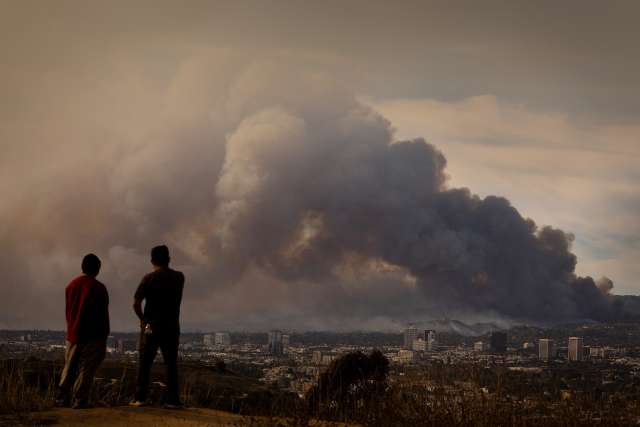
Jan. 7 marks one year since wildfire erupted over the Pacific Palisades. By month’s end, more than 10 wildfires — including the Palisades, Eaton, Hurst, Kenneth, Hughes and Sepulveda fires – had ignited, burning more than 55,000 acres of land, destroying nearly 16,000 homes and claiming approximately 440 lives.
Though the fires were extinguished, their effects live on. One year later, UCLA Health experts say long-term threats remain to lung health, mental well-being and overall community wellness.
“This was a catastrophic event that changed much of Los Angeles — its community, its landscape and our health,” says David Eisenman, MD, professor-in-residence at the David Geffen School of Medicine at UCLA and the Fielding School of Public Health.
“We are, not surprisingly, still suffering the consequences in many ways,” he said. “Families have not returned to their homes, and high levels of pollutants remain in communities. It’s a tough place to be a year later.”
Lung health
The wildfires triggered widespread declines in air quality, primarily affecting individuals with prolonged exposure or preexisting respiratory conditions. Smoke from burned vegetation, combined with airborne toxins from human-made materials, contaminated homes and increased exposure to particulate matter.
For many residents, this exposure marked the beginning of ongoing health challenges.
While many people experienced short-term upper-respiratory symptoms — such as coughing, sore throat, itchy eyes and wheezing — that resolved within days, others report lingering symptoms.
“Initially, I definitely saw a spike in patients presenting with exacerbations or flare-ups of their lung condition, which was most commonly asthma or COPD (chronic obstructive pulmonary disease),” says May-Lin Wilgus, MD, pulmonologist and associate clinical professor at UCLA Health. “But I think there were a lot of people who did not seek medical care at the time and later experienced increased symptoms.
“Many individuals who followed up with me six months later also mentioned their symptoms flared with the fires,” she adds. “These patients often had continued exposures — such as returning to smoke-damaged homes or encountering high levels of heavy-metal contamination — so it does seem to be a trigger.”
Dr. Wilgus advises communities to prepare for future wildfires by improving indoor air quality with HEPA (High Efficiency Particulate Matter) air filters; keeping emergency food, water and medications on hand; establishing evacuation plans; and generally raising awareness about the health risks.
“We have a very wide network of pulmonology clinics throughout the region, where we are treating patients who may have been affected,” says Dr. Wilgus. “Throughout Los Angeles, we need to be more aware and prepared, as well as support ongoing research to help reduce these impacts.”
Mental health
Mental health has emerged as a primary long-term concern, as residents continue to cope with wildfire-related trauma.
“People most closely affected — such as those who lost their houses or belongings — often experience the greatest impact. Individuals with a history of prolonged anxiety or depression also tend to have difficulty recovering from events of this kind,” says Emanuel Maidenberg, PhD, clinical professor of psychiatry and biobehavioral sciences at the David Geffen School of Medicine.
“This is a really traumatic event that takes time to recover from,” he said. “So, these populations may experience slower recovery because the reminders are ever present, and their lives have changed.”
In addition to the trauma of the fires themselves, many residents still face housing instability.
“This has caused a lot of disruption to children’s schooling, time off from work, and significant stress related to navigating insurance claims and rebuilding homes — all while families are still trying to process the trauma,” Dr. Eisenman says. “Right now, we are studying the mental health consequences in the community, and we would expect to see elevated rates of depression, post-traumatic stress disorder, and anxiety among people who were evacuated from the fires.”
Dr. Maidenberg says that as visible reminders of the wildfires – such as scorched land and damaged homes – diminish, community recovery will progress, particularly with the support of expanded mental health services.
“Over time, people will talk about it less, and we will think about it less often,” he explains. “But I think we are all a little bit more cautious, apprehensive and mindful of the initial shock, as well as the evolving emotions of sadness, fear and loss.”
The road ahead
Ultimately, at the one-year anniversary mark, researchers are still in the early stages of understanding the long-term health effect of the wildfires.
To expedite the learning process, Dr. Eisenman and Arash Naeim, MD, chief medical officer for clinical research at UCLA Health and a member of the UCLA Health Jonsson Comprehensive Cancer Center, established the UCLA Wildfire Impacted Communities Research Registry.
To date, the registry includes approximately 4,440 participants, all of whom were Los Angeles residents during the wildfires. By enrolling in the registry, participants are invited to take part in studies examining the short- and long-term health effects of the fires on themselves and their families.
“The registry allows UCLA doctors and (other) health care professionals to better understand the health needs of patients and our community, and to conduct the studies needed to support them now and in the future,” Dr. Eisenman says. “There will be other fires, and we don’t fully understand their effects on people’s health. We really need to know this in order to better protect health.”
One study, for example, is examining the physical and mental health impacts on residents who stayed behind to protect their homes against the fires, rather than evacuating immediately.
“We expect that individuals who stayed behind to defend their homes will experience less fire-related property damage,” says Dr. Eisenman. “At the same time, however, we anticipate that these individuals will face more health consequences from staying behind, including lung problems, physical injuries and mental health concerns. And so, we are highlighting the trade-off that people face when deciding to defend their home.”
As communities across Los Angeles continue to recover, the wildfires have underscored the importance of resilience and unity, says Dr. Eisenman. The support of UCLA has been pivotal to this progress.
“UCLA really stepped up in a lot of ways,” says Dr. Eisenman. “During the Palisades fire, a lot of our faculty and staff across UCLA were affected. The administration moved quickly to support staff, while the academic community worked to gather data and use it for the betterment of the community.
“The wildfires continue to teach us that, in the end, communities must come together,” he says. “Learning how to evacuate safely, prepare as a community, and support each other during a disaster is crucial — and coming together makes the whole community stronger.”