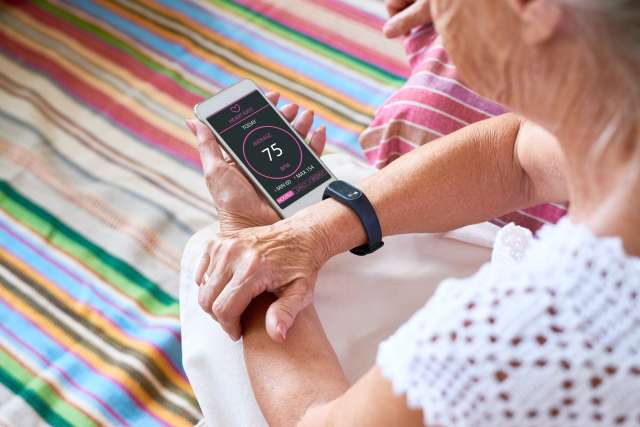
The availability of personal health data that people can access is changing and growing every day. Thanks to health apps and wearable technology, such as watches and rings, you can receive constant information about your health and habits outside of traditional clinical settings.
Using digital health data, you can monitor many aspects of your health from the comfort of your home, including:
- Blood oxygen levels
- Calorie consumption and use
- Heart health
- Menstrual cycles
- Respiratory rate
- Sleep
- Stress
The challenge is that the amount of data you receive can be overwhelming, unreliable and difficult to interpret. The trick is knowing which information actually deserves your attention.
Next time you review your personal health data, consider these important facts:
1. Your wearable technology data should not be confused with a diagnosis
Wearable health devices can tell you a lot about your health. But the data you receive cannot paint a complete picture and should never be considered at the same level as a medical diagnosis. If your health device suggests that you are getting poor sleep, it doesn't automatically mean that you have a sleep disorder.
When physicians make a diagnosis, they take medical data into account. But they also consider many other aspects of your health including family history, health history, symptoms and environment.
Most consumer health metrics are generated by proprietary algorithms — more useful for identifying patterns than making a medical diagnosis. Additionally, the accuracy and sensitivity of personal health devices cannot always be trusted.
In one study, researchers examined 42 scientific reviews of consumer wearables. They concluded that for most health measurables, device accuracy was inconsistent across various groups and settings. Heart rate measurement and atrial fibrillation detection were the only two metrics where devices consistently displayed clinical benefit.
2. Trends are more valuable than individual readings for wearable health monitoring
It's natural to worry about what an unusual score or data metric from a wearable device says about your health. But instead of assigning meaning to one suspicious reading, look at that measurable over a couple of weeks to get a more complete picture.
For instance, if your resting heart rate suddenly seems higher than usual, look back at the previous two weeks or watch what happens over the next few days. If your data is truly trending toward a higher heart rate — and the reading isn't a one-off — consult your doctor to see what it may mean.
Wearable devices tend to use advanced algorithms, which can be prone to errors or bias. Relying solely on one possibly incorrect data point may cause you to misinterpret what's really going on with your health.
The good news is that experts are still working to develop tools for testing, data protection and reliability when it comes to digital health devices.
3. Constant health notifications may create more noise than value
Alerts may initially make you feel as though you are in better control of your health. But if that notification is not causing you to take action, it may eventually become noise. With too much noise, you may start to tune out those alerts — potentially missing out on information that requires medical attention or lifestyle changes.
Talk to your doctor about which alerts should matter most for you and when you should act on them. If changes in a particular data point would never be an immediate concern, then it may not be worth tracking.
Tips to reduce your health data noise include:
- Choose only a small number of data points to monitor
- Disable any nonessential notifications
- Set a predetermined time to check your data and look for trends
4. Not all digital health data is created equal
The accuracy of wearable devices can vary depending on the specific device and the metric it is measuring. Some data points seem more reliably tracked with a health device than others.
A review of 114 studies involving 118 unique health devices and 26 mobile apps found that the digital data generated had a clear possible positive effect on health outcomes for only three chronic conditions:
- Asthma
- Coronary artery disease
- Heart failure
For some other conditions, specifically hypertension and cardiac arrhythmias, the data was not always clear, but monitoring that data did still lead to positive outcomes for those patients. For most conditions, there was limited evidence that wearable devices provide clear data or that they contribute to meaningful health changes.
Before you react to any health metric from wearable technology, ask yourself:
- What is this device measuring?
- How does the device measure it?
- Has the technology been validated?
- Is this a wellness metric or a medical measurement?
- What would I do differently based on this number?
Having that information can help you prioritize and manage the digital health data you receive. But before making any big lifestyle or health changes, it is always a good idea to consult your primary care physician.