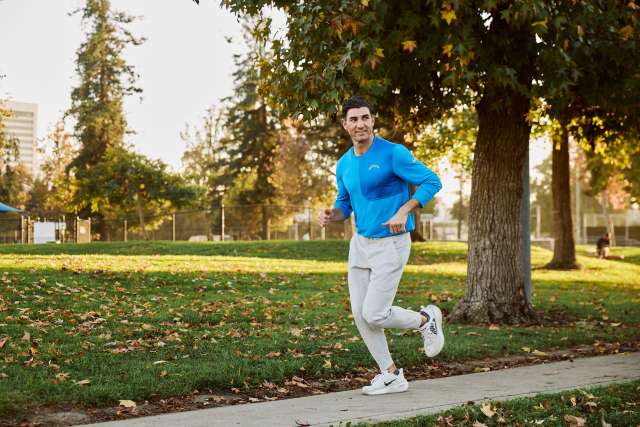
There’s no such thing as being too old or too out-of-shape to train for a marathon, says Josh Goldman, MD, a UCLA Health sports medicine specialist, team physician for the Los Angeles Chargers and long-distance runner.
With the ASICS Los Angeles Marathon set for March 8, most participants began their preparations weeks or even months ago. But it’s not too late to enhance your training or start prepping for the 2027 event, Dr. Goldman says.
“No matter your fitness background, you can certainly train for a marathon,” he says. “But what that training plan looks like and how long it runs for is very much going to depend on where you are foundationally with your running and your fitness.”
Regardless of where you start, all runners can benefit from cross-training with other forms of exercise, adding miles gradually and prioritizing rest and recovery, says Dr. Goldman, a lifelong runner whose favorite race is the half marathon. While he says he could “talk about running for hours,” he boiled down his top training tips for runners at all levels:
Consider your goals
Are you trying to qualify for the elite Boston Marathon, which requires specific finish-time standards based on race and gender, or just aiming to complete 26.2 miles as a personal challenge or community activity? Your aim dictates your training approach, Dr. Goldman says. Walking a marathon requires a different training plan than running one, for example, and Boston aspirants may have different speed considerations than recreational runners.
Once you’re clear on your race goals, you can find a training plan online or ask an AI chatbot to create one for you based on your current fitness status, marathon date and target finish time. Or, better yet …
Get a coach/find a community
Dr. Goldman recommends people who are new to running consider joining a run club for access to coaches and community support. Clubs such as LA Leggers and the South Bay Runners Club provide training structure, race discounts and a built-in community of fellow athletes ready to share their experiences and cheer you on.
Marathon prep requires long training runs that can be “pretty mind-numbing and lonely if you’re doing them by yourself,” Dr. Goldman says. Run clubs – including his own Electric Athletic Club – turn those monotonous training sessions into social events. Many clubs also offer access to certified coaches, who provide personalized guidance and evidence-based training techniques that can be especially helpful for new runners, he says: “I do encourage some supervision and coaching, if you can.”
If there’s no run club where you live, consider an online community.
Start slow
Running a marathon means conditioning your body and mind for 26.2 consecutive miles, which requires gradually increasing distance over time. Many people think that the harder and faster they go during training, the better the results. But that’s not the case for marathon runners, Dr. Goldman says.
He points to a recent study that found that the biggest predictor of marathon success was a large amount of “long, slow, easy, chill miles.” This type of running is considered “zone one” of the pyramid approach to marathon training, he explains. According to this model, marathon preppers spend most of their training time logging relaxed miles in zone one; devote a moderate amount of training to the race-pace running considered zone two; and just a small amount of time doing the all-out, fast running of zone three. This approach helps prevent injury and overtraining, Dr. Goldman says.
“It’s very counterintuitive, but a huge volume of zone one training is actually the most predictive of race-day success,” he says.
It’s best to add mileage slowly, he adds. Increasing distance by 10% per week is a safe approach, especially for new runners. In other words, if you regularly cover 3 miles, don’t suddenly try 10. A recent meta-analysis found such “training spikes” were most predictive of injury, he says.
Include cross-training
“Cross-training is absolutely essential” to marathon training, says Dr. Goldman, who advises incorporating both strength and mobility/flexibility training into any marathon-prep plan.
Running is a linear sport that conditions forward-moving muscles. Strengthening the core, back and lateral leg muscles is “important for maintaining a normal stride and a normal running mechanic that will very much fatigue on you and cause lots of problems on race day if you do not train them,” he says.
Dr. Goldman led a recent study that looked at the benefits of strength training among adolescent members of a group called Students Run L.A., which trains middle- and high-school students to run a marathon. It found that students who participated in twice-weekly strength-training sessions saw a 30% reduction in injury rates.
“We’re giving them more work to do but significantly lowering their injury risk by making it strategic, focused on the most common injuries in running and really strength-training based,” he says.
“Runner’s knee,” or patellofemoral pain syndrome, is the most common running injury, Dr. Goldman says. When feet, ankles or hips are weak, the kneecap wiggles side to side, which causes friction, swelling and pain. Cross-training strengthens those muscles to keep the kneecap in place. Consider resistance training to strengthen the core, low back and hip abductor muscles, along with yoga or stretching to support flexibility and balance.
Build recovery into your training plan
You’re adding miles slowly, logging lots of zone-one time, cross-training and running with a club. But there may still be a critical element missing from your marathon training: rest and recovery.
Most people focus on training load, pushing themselves to go harder and faster, but recovery is what allows us to increase that load, Dr. Goldman says: “The recovery component of the training is equally as important as the load itself.”
Marathon training recovery comprises sleep, nutrition and soft-tissue recovery.
“Sleep is number one,” Dr. Goldman says, noting that increasing exercise means the body needs more rest.
While most of us can’t realistically get the 10 to 12 hours a night touted by pro athletes such as Tom Brady and LeBron James, keeping a consistent bedtime can improve recovery and performance, Dr. Goldman says. A study of collegiate athletes at UCLA comparing sleep duration with sleep consistency found that going to sleep within the same one-hour window each night led to similar performance gains and recovery metrics as sleeping 10 hours a night.
When we keep a consistent bedtime, we have faster sleep onset, and the first few hours of sleep are most critical for recovery, Dr. Goldman says.
Regarding nutrition, many distance runners are familiar with the gel packets that can be consumed along the race route to provide quick fuel. But nutrition throughout training is just as important as race-day intake.
Long-distance running traumatizes tissues, which need to rebuild afterward.
“We can speed that up by giving our bodies the building blocks for recovery,” Dr. Goldman says, “which are protein, collagen and carbohydrates that it needs to repair and regenerate all the tissue damage that was done during these longer training cycles.”
So while you might be tempted to scarf down whatever junk food is in the house after a long training run, it’s better for recovery to consume protein and carbs – maybe some chicken and a sweet potato.
We can also help repair tissue damage incurred during training with simple modalities such as compression tights and boots or doing the yoga pose known as “legs up the wall.” To do it, lie on the floor and extend your legs perpendicularly, resting them against a wall.
This move can “significantly improve your ability to clear all that excess fluid out of your legs and have your muscles feel better and ready to run again more quickly,” Dr. Goldman says.
All about the preparation
A comprehensive marathon training program that incorporates slow-and-steady mileage increases, cross-training and recovery prepares the body for its best performance and quickest recovery.
“We think so much about race day,” Dr. Goldman says, “but 99% of your miles are not run on race day.”