Fiber is having its moment. The carbohydrate found in plant foods – fruits, vegetables, whole grains, legumes, nuts and seeds – is key to a healthy diet and people are taking note.
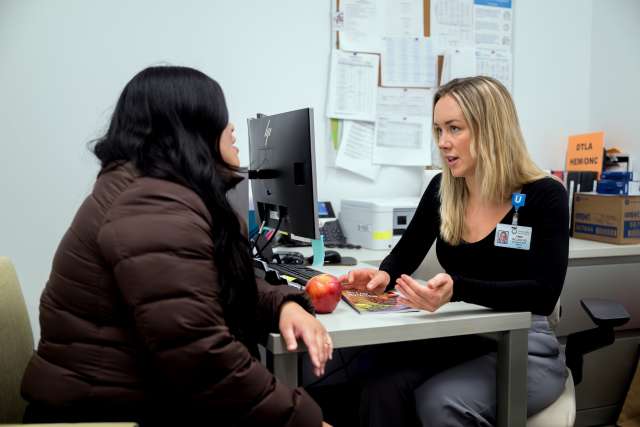
Emma Veilleux, RDN, senior dietitian for the Simms/Mann UCLA Center for Integrative Oncology, calls fiber one of her favorite topics to discuss – which she did, in the recent webinar “Fueling Better with Fiber.”
It’s one of a series of nutrition webinars offered by the Simms/Mann Center, which provides free psychosocial support for people undergoing cancer treatment at UCLA Health, from diagnosis through survivorship.
In the presentation, Veilleux explained the two kinds of fiber and how they work as a team, the importance of fiber for people on the cancer journey and how to get enough fiber in your diet.
Two kinds of fiber
Fiber is undigestible, able to pass through the body virtually intact. While in route, it has a job to do. The exact job depends on the type of fiber: soluble or insoluble.
Soluble fiber mixes with water and dissolves into a gel in the gut, Veilleux explained in the webinar, which helps to slow digestion, lower cholesterol, stabilize blood sugar and firm up the stool.
“It’s like a slow, gentle river of a jelly substance moving through your colon,” Veilleux said.
“It helps slow things down through your intestines,” she said. “If you’re having diarrhea, eating more soluble fiber can help reduce it. If you’re going through treatment – chemotherapy, radiation – diarrhea can be a common side effect, also with certain targeted therapies or immunotherapies. Upping your soluble fiber intake can help.”
Veilleux describes insoluble fiber as “like a broom that’s helping to push things through your intestines.”
Proper hydration is important for the function of both types of fiber: Soluble fiber needs water to form the gel that helps it pass through the digestive system; insoluble fiber needs to soak up water to soften and bulk up the stool.
Most plant-based foods have both forms of fiber, Veilleux said. “As long as you’re getting enough fiber overall from a variety of plant sources you’re probably getting enough of both.”
Fiber’s value during cancer recovery
Along with easing diarrhea, Veilleux said, fiber can help people who are in recovery:
- Manage constipation. This can be a side effect of opioids, chemotherapy and reduced activity during recovery.
- Maintain healthy blood sugar. Some cancer treatments, such as steroids and certain chemotherapies, raise blood sugar.
- Sustain a healthy weight. Weight management can be a goal in survivorship; fiber-rich foods are filling and calorie efficient.
- Reduce systemic inflammation. Chronic inflammation drives cancer progression, and high-fiber diets are associated with lower inflammatory markers.
- Optimize heart and metabolic health. Many cancer survivors have elevated cardiac and metabolic risk from treatment. Soluble fiber reduces LDL (bad) cholesterol by keeping it from being absorbed into the bloodstream.
- Protect the gut lining. Butyrate, a fatty acid that is produced from fiber fermentation, helps to maintain the integrity of the gut wall.
Veilleux noted that fiber must be closely monitored for people who have severe chemotherapy-induced diarrhea; are experiencing inflammation after radiation (enteritis); or have a very low white blood count (neutropenia), which can be caused by certain cancer treatments.
Caution is also advised for people who have had recent bowel surgery or a history of bowel obstruction or active mouth/gut sores.
It’s best to consult with a dietitian before increasing fiber intake.
How much do you need?
The national recommendation for people up until age 50 is 25 grams of fiber per day for women and 30 grams per day for men. That drops to 21 grams for women, 30 grams for men older than 50.
But those are minimum amounts, Veilleux said.
“I typically encourage my patients to eat 35 to 40 grams of fiber per day. It may take some time to work up to that,” she said.
The most practical way to start is to just look at your plate, she says. Are there plants on it? If you have a healthy selection of foods, the fiber will take care of itself. Veilleux said it may be helpful to keep a food journal for a day or two as you begin to increase fiber, to get a sense of your average fiber intake.
If you’re not hitting your goal, increase it slowly, about 5 grams per week, she said.
“The important thing is to go slow when increasing, because it can cause some unpleasant side effects,” she said. “Gas, bloating, cramping – that’s normal, but it’s not comfortable.”’
General tips
Veilleux had this advice for anyone looking to improve their fiber intake:
- Make plants the main characters in your meal and put animal products in a supporting role, about a 67% to 33% ratio.
- Fiber supplements are acceptable options, but they should not be a replacement for whole foods.
- Beans. “I really encourage my patients to eat a half-cup of beans or more a day,” she said. “Most half-cup servings have at least 7 grams of fiber in them.”
- Most importantly: “Do what works for you,” Veilleux said.